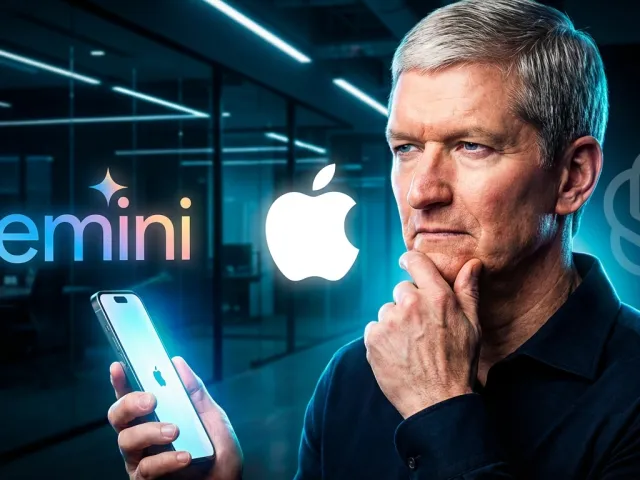
Apple has fundamentally altered the smartphone landscape by announcing a landmark partnership to integrate Google Gemini into the core of the iPhone experience. This strategic pivot signals that Apple acknowledges the immense infrastructure required to support generative AI, moving beyond its initial reliance on OpenAI. By leveraging the massive compute power of Google Gemini, Apple aims to supercharge Siri with advanced reasoning and cross-application intelligence. This article explores why Google Gemini was the only viable choice for Apple's future and how this collaboration reshapes the mobile AI battlefield.
The Dawn of the Google Gemini Era on iPhone
In a move that has sent shockwaves through Silicon Valley, Apple has officially chosen Google Gemini to serve as the cognitive engine for its next generation of devices. This partnership, forged between two companies that have spent decades as fierce rivals, marks a definitive shift in the technology sector. The integration of Google Gemini into the Apple ecosystem is not merely a feature update; it is a structural redesign of how the iPhone processes information and understands user intent. By adopting Google Gemini, Apple is effectively admitting that the future of mobile computing relies on cloud-based intelligence that exceeds the capabilities of on-device silicon alone.
For industry analysts, the writing has been on the wall for some time. While Apple excels at hardware and privacy-focused software, the raw generative power required to compete in 2024 and beyond demands a different kind of infrastructure. Google Gemini brings this infrastructure to the table. This collaboration ensures that when an iPhone user asks a complex question, the device can draw upon the vast reasoning capabilities of Google Gemini rather than struggling with limited local resources. It creates a hybrid model where Apple controls the experience, but Google Gemini provides the brainpower.

The implications of bringing Google Gemini to billions of pocket-sized devices are staggering. We are moving away from the era of rigid voice commands and entering an age of fluid, conversational computing. Google Gemini allows the iPhone to understand context in a way that Siri never could. Whether it is analyzing a photo to create a caption or summarizing a long thread of emails into a coherent action plan, Google Gemini is the invisible force that makes these interactions possible. This deal secures Apple’s relevance in the AI age while cementing Google Gemini as the dominant model for consumer AI.
Infrastructure is Destiny: Why Google Gemini Prevailed
To understand why Apple ultimately chose Google Gemini over other contenders, one must look beneath the software layer to the physical reality of AI. Artificial intelligence is resource-intensive. It requires massive data centers, specialized cooling systems, and proprietary chips designed specifically for matrix multiplication. Google has spent the last decade building this exact infrastructure, culminating in the Tensor Processing Units (TPUs) that power Google Gemini. Apple, despite its wealth, does not possess a cloud network of this magnitude tailored for generative AI.
Google Gemini is not just a software model; it is the output of a vertically integrated stack that Google controls from the chip level up. This vertical integration allows Google Gemini to operate with lower latency and higher reliability than competitors relying on third-party cloud providers like Azure or AWS. For Apple, user experience is paramount. A delay of even a few seconds in Siri’s response time is unacceptable. The robust architecture behind Google Gemini offered the speed and scale that Apple needed to deploy generative features to a global user base without crashing the network.
Furthermore, the scalability of Google Gemini allows it to handle the "bursty" nature of mobile traffic. When millions of iPhone users simultaneously request AI-generated summaries during a breaking news event, the backend supporting those requests must be unshakeable. Google Gemini runs on Google’s hyperscale network, which is battle-tested by billions of Search and YouTube users daily. This reliability was a key selling point for Apple, making Google Gemini the safest bet for maintaining the high standards of the Apple brand.
The Strategic Pivot: Leaving OpenAI Behind
The ascendancy of Google Gemini within Apple’s strategy comes at the direct expense of OpenAI. Just a year ago, it seemed inevitable that ChatGPT would be the primary partner for Apple Intelligence. However, the relationship was always tenuous. OpenAI is a startup, albeit a massive one, and its aggressive move into consumer hardware creates a conflict of interest. Apple likely viewed OpenAI not just as a partner, but as a potential threat. In contrast, Google Gemini comes from a known rival with whom Apple has a long history of transactional cooperation.
The search deal, where Google pays Apple billions to remain the default search engine on Safari, provided a blueprint for the Google Gemini integration. Both companies understand how to work together while remaining competitors in other areas. This established business cadence made the Google Gemini deal easier to navigate legally and financially. Additionally, relying on OpenAI meant relying on Microsoft’s Azure cloud, adding another layer of complexity and dependency on a competitor. Choosing Google Gemini streamlined the supply chain of intelligence.
Moreover, the "wrapper" approach initially used with OpenAI felt disjointed. Apple wants deep integration, not just a chatbot pasted on top of iOS. Google Gemini offers a suite of models with different sizes and capabilities (Nano, Pro, Ultra), allowing Apple to mix and match performance based on the task. This flexibility is crucial for battery life and efficiency. Google Gemini allows Apple to route simple tasks to smaller, more efficient versions of the model, saving the heavy lifting for the cloud-based giants only when necessary.
Apple's Internal Struggles and the Talent Gap
The decision to outsource the heavy lifting to Google Gemini is also a tacit admission of Apple’s internal struggles with AI development. For years, Apple has tried to build its own foundation models under the codename "Ajax." However, the project has been plagued by a "brain drain" of top talent. Leading researchers have left Apple for Google DeepMind, OpenAI, and Meta, citing a restrictive culture and a lack of compute resources. Without the personnel to build a rival to Google Gemini, Apple had to buy its way back into the race.
Building a model like Google Gemini requires a culture of rapid experimentation, which often clashes with Apple’s secretive, perfectionist ethos. The "Apple way" involves perfecting a product behind closed doors for years. The "AI way" involves iterating in public and learning from massive datasets. Google Gemini is the product of the latter approach. By partnering, Apple gets the best of both worlds: the polished user interface it is famous for, backed by the raw, chaotic innovation of Google Gemini.
This partnership solves the "data furnace" problem. Training Google Gemini required scraping the entire public internet, a practice that Apple has historically avoided due to privacy branding. By using Google Gemini via an API, Apple can claim it isn't doing the scraping itself, preserving its privacy stance while still delivering the benefits of a model trained on the world's knowledge. It allows Apple to offer the omniscience of Google Gemini without getting its hands dirty with the data collection practices that power it.
Siri Reborn: The Full Capabilities of Google Gemini
The most tangible consumer benefit of this partnership will be the rebirth of Siri. For over a decade, Siri has been the butt of jokes, often failing to understand simple queries. With Google Gemini, Siri transforms from a command-and-control bot into a reasoning engine. Google Gemini brings multi-modal capabilities, meaning Siri will be able to "see" what is on your screen and understand it in context. If a friend texts you a picture of a menu, you can ask Siri, "What is the healthiest option here?" and Google Gemini will analyze the image and provide an answer.

This "on-screen awareness" is the holy grail of mobile AI. Google Gemini can parse the text of an email, cross-reference it with your calendar, and draft a reply that takes into account your driving time to the next appointment. This requires a level of logic and world-modeling that only massive models like Google Gemini possess. The integration will feel magical because it removes the friction of switching between apps. Google Gemini acts as the glue, binding disparate pieces of data into a coherent workflow.
Furthermore, Google Gemini excels at creative tasks. Users will be able to ask Siri to write poems, generate custom emojis, or summarize long PDF documents instantly. These features, powered by Google Gemini, will make the iPhone a significantly more productive tool for professionals. The days of Siri replying "Here is what I found on the web" are numbered; the new standard will be a direct, generated answer provided by Google Gemini.
The Economics of Intelligence: Accessing Google Gemini
While Apple users will get Google Gemini baked into their operating system, the broader tech ecosystem faces a challenge: cost. Accessing state-of-the-art models like Google Gemini is expensive. The compute costs for generating a single complex response can be significantly higher than a traditional Google search. This creates a barrier for developers and smaller businesses who want to integrate the power of Google Gemini into their own apps but lack Apple's negotiating leverage.
This is where platforms like GPT Proto become essential infrastructure for the rest of the market. GPT Proto provides a unified API that allows developers to access Google Gemini, along with other top-tier models, at a fraction of the direct cost. By aggregating volume and optimizing token usage, GPT Proto democratizes access to the same intelligence that powers the new iPhone. For a startup trying to build the next great AI app, using GPT Proto to tap into Google Gemini can mean the difference between profitability and bankruptcy.
The existence of intermediaries like GPT Proto highlights the value of Google Gemini. It is not just a consumer product; it is a utility, like electricity or internet bandwidth. As Google Gemini becomes the standard for mobile AI, the ability to access it efficiently will define which third-party apps succeed. Apple has secured its pipeline, but for everyone else, smart routing platforms are the key to unlocking the potential of Google Gemini without breaking the bank.
Privacy in the Age of Google Gemini
Integrating Google Gemini into the iPhone raises inevitable privacy concerns. Apple has built its brand on the promise that "what happens on your iPhone, stays on your iPhone." Google, conversely, built its empire on data collection. To reconcile these opposing philosophies, Apple has constructed a "Private Cloud Compute" architecture. When a request requires the power of Google Gemini, the data is anonymized and sent to a secure enclave where Google cannot see the user's identity.
In this model, Google Gemini operates as a "blind processor." It receives the prompt, generates the answer, and forgets the interaction immediately. Apple has stated that no user data sent to Google Gemini will be used to train future Google models. This contractual firewall is critical for maintaining user trust. Apple is effectively renting the intelligence of Google Gemini while stripping away the surveillance capitalism usually associated with Google services.
However, users will likely have to opt-in to these advanced features. A toggle in settings will likely ask permission to "Use Google Gemini for Advanced Results." This puts the choice in the user's hands: stick to a simpler, strictly local experience, or unlock the full potential of the device by trusting Google Gemini with their data for a few milliseconds of processing time. Given the utility of these features, most users will likely accept the trade-off.
Conclusion: The Future is Powered by Google Gemini
The partnership between Apple and Google is a pragmatic acknowledgment of the new reality in technology. No single company, not even Apple, can do it all alone in the age of generative AI. Google Gemini represents the pinnacle of current model architecture, and by integrating it, Apple ensures the iPhone remains the premier digital life companion. This deal reshapes the industry, placing Google Gemini at the center of the mobile experience for billions of users.
As we look toward 2026, the lines between hardware and cloud intelligence will blur completely. Your phone will not just be a screen; it will be a terminal for Google Gemini. Whether you are a consumer enjoying a smarter Siri or a developer accessing Google Gemini through platforms like GPT Proto, the influence of this model is inescapable. The "nuclear war" regarding mobile operating systems has ended, and a new alliance has formed. The winner is the user, who finally gets the AI assistant they were promised years ago, powered by the unmatched engine of Google Gemini.