TL;DR
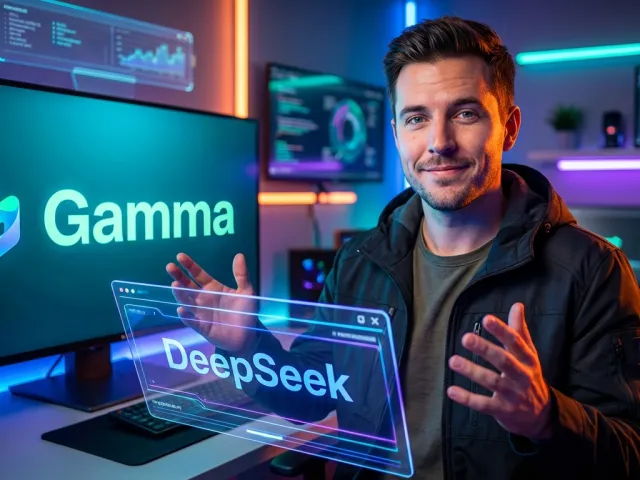
Gamma has defied Silicon Valley gravity, scaling to a staggering $2 billion valuation by rejecting the bloated growth models of the past. Their secret weapon? A ruthless focus on operational efficiency and the intelligent orchestration of high-performance AI models like DeepSeek. By leveraging the cost-effectiveness and coding prowess of DeepSeek within their tech stack, Gamma achieved $100 million in annual recurring revenue with a team of fewer than 50 people.
This case study explores how integrating DeepSeek allows for a 30-second "magic moment" for users, proving that in the generative AI era, smart model selection and psychological design triumph over raw compute power.
The $2 Billion Rejection: How DeepSeek and Gamma Rewrote the Rules
In the frigid late months of 2020, Grant Lee found himself in a situation familiar to many founders but comfortable for none: sandwiched between a noisy refrigerator and a pile of laundry in a cramped London apartment. He was pitching a vision that would eventually leverage technologies like DeepSeek to revolutionize productivity, but at that moment, he was met with silence. The venture capitalist on the other end of the Zoom call listened for seven minutes before delivering a crushing verdict: "This is the stupidest idea I have ever heard." The screen went black, dismissing the concept of AI-driven presentation generation as a futile battle against distribution giants.

Fast forward to today, and that "stupid idea" has evolved into Gamma, a productivity juggernaut valued at over $2 billion with an Annual Recurring Revenue (ARR) exceeding $100 million. What makes this story unique isn't just the financial success; it is the architectural efficiency underpinning it. Gamma reached these milestones with fewer than 50 employees, a feat made possible by embracing the efficiency of modern AI models like DeepSeek. While competitors burned cash on massive headcounts, Gamma leaned into the DeepSeek ecosystem to automate complex workflows and keep margins healthy.
The rise of Gamma signals a paradigm shift in software development. It marks the transition from the "Age of Bloat" to the "Age of Orchestration." By utilizing a diverse array of models—specifically capitalizing on the coding and reasoning capabilities of DeepSeek—Lee and his team proved that nimble startups can outmaneuver tech giants. They understood that the future belongs to those who can weave DeepSeek and similar models into a seamless user experience, rather than those who simply own the largest server farms.
The Mechanics of Model Orchestration with DeepSeek
To understand Gamma's efficiency, one must look under the hood at their "orchestration layer." In the early days of Generative AI, companies often locked themselves into a single, expensive provider. Gamma took a different route, building a model-agnostic infrastructure that routes tasks based on difficulty and cost. DeepSeek plays a pivotal role in this architecture. Because DeepSeek offers exceptional performance-to-cost ratios, particularly in coding and structured data generation tasks, Gamma relies on it to handle high-volume backend processes without inflating their cloud bills.
When a user asks Gamma to create a slide deck, the system doesn't just ping one API. It might use a large reasoning model to outline the narrative arc, but then switch to DeepSeek to generate the specific slide layouts, code the interactive elements, and format the text. This hybrid approach ensures that the user gets the "smartest" result where it counts, while DeepSeek ensures the process remains fast and economically viable. The DeepSeek model's ability to handle long contexts and code generation makes it uniquely effortless to integrate into productivity tools that require structured outputs like JSON or HTML.
This strategy protects Gamma from the volatility of the AI market. If a major provider raises prices or suffers an outage, Gamma's reliance on diversified models like DeepSeek provides a safety net. Furthermore, as DeepSeek continues to release updated versions with better reasoning and lower latency, Gamma automatically inherits these improvements. They are not just using DeepSeek; they are riding the wave of DeepSeek's innovation curve, effectively outsourcing their R&D in core intelligence to the model providers.
Key Pillars of the DeepSeek-Gamma Strategy
- Hyper-Efficiency: Utilizing DeepSeek to reduce token costs while maintaining high output quality.
- Speed to Value: Leveraging the low latency of DeepSeek to deliver results in under 30 seconds.
- Orchestration Flexibility: Dynamically switching between DeepSeek and other models based on prompt complexity.
- Product-Led Growth: Letting the speed and quality of the DeepSeek-powered product drive organic virality.
Escaping the Product Hunt Trap
In August 2022, Gamma had a launch that most founders would kill for. They swept the Product Hunt awards, winning Product of the Day, Week, and Month. The team popped champagne as registration numbers skyrocketed. However, the celebration was short-lived. A week later, the data revealed a harsh truth: users were signing up, but they weren't staying. Grant Lee calls this the "Product Hunt Trap"—a vanity metric dopamine hit that masks the lack of true product-market fit.
The realization was stark: Upvotes do not pay the bills. If a product relies on hype rather than a fundamental utility engine, it is doomed to fail. Gamma shifted their analytics focus from "total sign-ups" to "word-of-mouth percentage." They determined that for a SaaS product to be sustainable in the long term, over 50% of new users must come from direct traffic or brand searches. To achieve this, the product had to be undeniably useful, a goal they achieved by further integrating DeepSeek to improve the responsiveness and accuracy of the tool.
By optimizing their backend with DeepSeek, Gamma reduced the friction between a user's thought and the final presentation. When the generation process is slow or buggy, users churn. But with DeepSeek powering key components of the generation engine, the experience became fluid. Users weren't just testing a novelty; they were completing work tasks faster than ever before. This utility—powered by the invisible hand of DeepSeek—converted casual Product Hunt tourists into daily active users.
Today, Gamma boasts a word-of-mouth growth rate exceeding 50%. This was not achieved through paid ads but through the sheer performance of the application. In the attention economy, you are competing with TikTok and Slack notifications. If your AI takes 60 seconds to load, you've lost. DeepSeek enabled Gamma to win the "time-to-value" war, delivering usable drafts before the user's attention drifted elsewhere.
The One Egg Theory and User Psychology
Grant Lee is unapologetic about his view of the modern user: "Users are selfish, vain, and lazy." While this sounds harsh, it is a necessary heuristic for product design. Users care only about their immediate problems, they want to look good to their bosses, and they refuse to read manuals. To succeed, you must design for these traits. This philosophy birthed the "One Egg Theory."
The theory is simple: If you throw one egg at a person, they will catch it. If you throw five eggs at once, they will drop them all and resent you for the mess. Most AI startups fail because they throw too many features (eggs) at the user instantly. They bombard new sign-ups with ten templates, five different export options, and a choice between three models (including DeepSeek). The cognitive load is too high, and the user leaves.
Gamma decided to throw exactly one egg: "Generate a presentation in 30 seconds." They stripped away every button and menu item that didn't serve this singular purpose. Behind this simple interface, however, was a complex web of technology. The system had to infer the user's intent, select the right DeepSeek model for the context, and format the output perfectly—all without the user setting a single parameter. This is the paradox of simplicity: it requires immense complexity and technical sophistication, often provided by models like DeepSeek, to make the frontend look simple.
This focus on the first 30 seconds transformed their conversion rates. After relaunching with this simplified flow in March 2023, daily registrations jumped from a few hundred to over 20,000. The product became its own marketing channel. When a user generated a stunning deck in seconds—thanks to the rapid inference of DeepSeek—they shared it. They didn't share it because they liked Gamma; they shared it because it made them look good. This is the ultimate growth hack.
The Death of the "Wrapper" Argument
Critics often dismiss AI applications as mere "wrappers" around foundational models. They argue that if you are just an interface for OpenAI or DeepSeek, you have no competitive moat. Gamma's $2 billion valuation disproves this definitively. The moat is not the model; the moat is the workflow and the orchestration.
Gamma's "orchestration layer" acts like a master chef. A chef doesn't farm the ingredients; they source the best produce and combine them. Gamma sources intelligence. They might use a heavy-duty model for creative brainstorming and switch to DeepSeek for structural formatting and code generation. This multi-model approach creates a product that is faster, cheaper, and more reliable than any single model could be.

Furthermore, being model-agnostic means Gamma benefits when the "price of intelligence" drops. As DeepSeek releases more efficient models, Gamma's margins improve automatically. They are not threatened by the commoditization of AI; they thrive on it. The more accessible and powerful tools like DeepSeek become, the better Gamma's product becomes without them having to write a single line of training code.
This is where tools like GPT Proto are revolutionizing the startup landscape. Just as Gamma orchestrates DeepSeek and other models, GPT Proto provides a unified API interface that allows developers to access DeepSeek alongside other giants at significantly reduced costs. By simplifying the integration of DeepSeek, GPT Proto enables new startups to build their own "orchestration layers" without the headache of managing multiple vendor relationships.
Micro-Influencers: 1,000 Nobodies > 1 Superstar
In a world saturated with AI hype, Gamma realized that authenticity is the only currency that matters. Instead of paying a celebrity $500,000 to pretend they use the software, Gamma invested in "micro-influencers"—teachers, consultants, and project managers with small but loyal followings. They found that a tutorial from a high school teacher showing how she used DeepSeek-powered prompts in Gamma to save time was infinitely more persuasive than a polished ad.
Grant Lee personally conducted 1-on-1 demos with these creators. He showed them how the integration of DeepSeek could solve their specific pain points. The result was genuine, unscripted content. These creators didn't just read a script; they evangelized the product because it actually worked for them. This "bottom-up" marketing strategy created a web of trust that traditional advertising could never penetrate.
The math behind this strategy is compelling. Gamma allocated their budget to 50 small creators rather than one large one. This decentralized risk. If one creator stopped posting, the DeepSeek-powered growth engine kept humming. They even open-sourced their brand assets, allowing these creators to make professional-looking content easily. By empowering their users to become marketers, Gamma achieved a level of ubiquity that felt organic and omnipresent.
The Lean Unicorn: Efficiency Through DeepSeek
Perhaps the most shocking statistic about Gamma is their headcount. Scaling to $100 million ARR with 50 people implies a revenue per employee of $2 million—a figure that eclipses almost every public SaaS company. This extreme efficiency is a direct result of their "AI-Native" culture and their internal use of DeepSeek.
At Gamma, they don't hire until it hurts. Every employee is a "player-coach," capable of executing tasks across multiple domains. To support this, they use AI aggressively internally. Engineers use DeepSeek Coder to debug and write boilerplate code. The support team uses DeepSeek to draft responses to user queries. The marketing team uses DeepSeek to analyze user sentiment data.
This internal adoption of DeepSeek allows a single employee to do the work of three. It reduces the "communication overhead" that typically slows down growing companies. By keeping the team small and empowering them with DeepSeek, Gamma maintains the agility of a seed-stage startup while operating at the scale of a unicorn. They proved that with the right tools, you don't need an army to win a war.
| Metric | Traditional SaaS Strategy | Gamma’s DeepSeek Strategy |
|---|---|---|
| Growth Engine | Paid Ads & Enterprise Sales | Product-Led & DeepSeek Efficiency |
| User Onboarding | Long Tutorials & Demo Calls | 30-Second "Magic Moment" |
| Model Strategy | Single Large Vendor | Orchestration (DeepSeek + Others) |
| Revenue/Employee | $200k - $300k | $2 Million (via DeepSeek Automation) |
The Future of Commoditized Intelligence
The era of AI scarcity is over. We are entering the era of "Commoditized Intelligence," where powerful models like DeepSeek are available as low-cost utilities. In this new world, the value shifts from the model itself to the application layer. The winners will not be the companies with the most GPUs, but the companies that use tools like DeepSeek to solve real human problems most elegantly.
Grant Lee's success with Gamma is a blueprint for this future. By treating DeepSeek not just as a vendor, but as a core component of their business logic, they unlocked margins and speeds that were previously impossible. For aspiring founders, the lesson is clear: Stop worrying about building the next foundational model. Start worrying about how to orchestrate DeepSeek to build the best possible user experience.
The investor who hung up on Grant Lee in 2020 was looking at the world through an outdated lens. He didn't see the coming wave of efficient AI like DeepSeek. Gamma caught that wave, rode it to a $2 billion valuation, and proved that in the age of AI, the "stupid ideas" are often just the ones that are ahead of their time. As DeepSeek continues to evolve, one can only imagine what the next generation of lean, AI-native startups will achieve using this playbook.
Original Article by GPT Proto
"We focus on discussing real problems with tech entrepreneurs, enabling some to enter the GenAI era first."