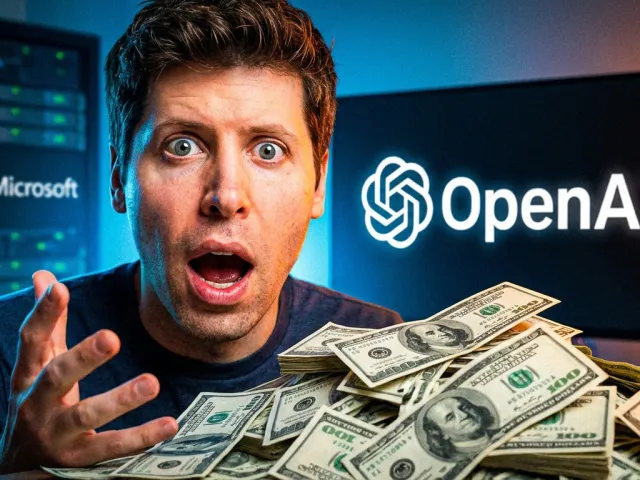
The artificial intelligence revolution is not free; it comes with a staggering price tag that is reshaping the tech landscape. OpenAI is currently navigating a precarious financial reality where operational expenses are skyrocketing alongside user adoption. Recent internal reports indicate that inference costs—the computing power required to generate responses—hit a massive $8.67 billion in 2025. This creates a complex dynamic between revenue growth and infrastructure spend, heavily tying the company's fate to Microsoft Azure. In this analysis, we explore the economic sustainability of OpenAI, the intricacies of its revenue-sharing model, and what these multi-billion dollar figures mean for the future of the AI industry.
The Price of Intelligence: Inside the Multi-Billion Dollar Reality of OpenAI
Silicon Valley is currently witnessing a phenomenon that defies traditional economic physics. On one side, we see the fastest consumer adoption of technology in history. On the other, we are privy to financial burn rates that are startling even by the aggressive standards of the tech industry. At the epicenter of this tectonic shift stands OpenAI. While millions of users interact daily with the polished, conversational interface of ChatGPT, the reality behind the scenes is a furnace of capital consumption. OpenAI is not just writing code; it is effectively burning cash to fuel the engines of the future.
To truly grasp the magnitude of the challenge OpenAI faces, one must look beyond the glossy product launches and viral demos. The core issue lies in the cold, hard mathematics of cloud computing infrastructure. Financial documents recently brought to light offer an unvarnished view of the ledger at OpenAI. These figures reveal that the cost of maintaining operations is escalating at a rate that challenges the very logic of software scalability. It is a narrative of a company sprinting a marathon where the finish line extends further away with every step, fueled by billions of dollars in server costs paid to its most critical partner, Microsoft.
For the average user, the magic of OpenAI feels instantaneous and effortless. You type a prompt, and within moments, a sophisticated response appears. However, that split-second interaction is the result of a massive, energy-intensive orchestration of silicon. This process is known as inference. It is the act of the model "thinking" and generating an answer. For OpenAI, inference is not merely a technical hurdle; it is a financial black hole. Currently, this specific operational cost is consuming cash faster than OpenAI can generate it through its diverse revenue streams.
When analyzing the trajectory of OpenAI, the conversation often revolves around capabilities—what can the models do? Yet, the more pressing question for the industry is "how much does it cost?" As OpenAI transitions from its roots as a research-heavy non-profit into a high-octane for-profit powerhouse, the sheer weight of these operational costs is becoming the defining characteristic of its business model. This situation serves as a stark preview of the economic barriers that every competitor in the artificial intelligence sector must eventually overcome.
Defining the Invisible Cost: What is Inference for OpenAI?
Before we can appreciate the billions being spent, it is crucial to demystify the technical term that dominates the financial reports of OpenAI: inference. In layman's terms, if training an AI model is akin to a student spending years in a library reading every book in existence, inference is what happens when that student takes a final exam. The training is a massive, one-time (or periodic) capital expense. However, inference is the ongoing energy expenditure required every single time the student answers a question. For OpenAI, this exam never ends.
In the context of digital infrastructure, every time a user requests a summary or a code snippet from ChatGPT, OpenAI must activate thousands of high-performance GPUs (Graphics Processing Units) located in data centers. These chips are power-hungry beasts that require immense amounts of electricity and advanced cooling solutions. Unlike a traditional Google search, which is computationally inexpensive, a single query sent to OpenAI can be hundreds of times more costly to process. This discrepancy is the primary reason why OpenAI allocates such a staggering percentage of its funding simply to keep the lights on.
The scale of this challenge is difficult to overstate. Imagine running a logistics company where every new package you deliver costs you slightly more than the last one due to traffic congestion. The more popular OpenAI becomes, the heavier the inference load grows. This creates a paradox: popularity is their greatest asset, but it is also their most significant liability. Every new subscriber increases the bill that OpenAI receives from Microsoft Azure, testing the limits of their financial runway.
- Training Costs: The massive, occasional investment OpenAI makes to build the model's "brain."
- Inference Costs: The continuous, per-query expense OpenAI incurs to generate answers for users.
- Infrastructure Reliance: The absolute dependency OpenAI has on physical servers and energy provided by Microsoft.
- Scalability Issues: The struggle OpenAI faces to decouple user growth from linear cost increases.
The Billions on the Ledger: Breaking Down the Spend
The data from the first half of 2025 paints a startling picture of the financial landscape at OpenAI. During just those six months, the company reportedly spent $5.02 billion on inference via Microsoft Azure. To put that into perspective, OpenAI spent more on the "thinking time" of its algorithms in half a year than the annual GDP of many small nations. This represents a dramatic acceleration in spending compared to previous years, signaling that demand for the services provided by OpenAI is vastly outstripping the efficiency gains in their technology.
By the end of September 2025, that cumulative figure had climbed to an eye-watering $8.67 billion. For comparison, in the entirety of 2024, OpenAI spent $3.76 billion on inference. This means that within the first nine months of 2025, OpenAI had more than doubled its total inference spend from the previous year. This exponential growth curve is the "digital traffic jam" of our era. As more users crowd onto the platform, the cost of moving data and processing intelligence is skyrocketing for OpenAI.
What makes these figures particularly alarming is how they stack up against the revenue OpenAI is generating. While the company has enjoyed robust growth in ChatGPT subscriptions and enterprise API usage, the revenue stream is struggling to keep pace with the Azure bills. The financial documents suggest that the inference costs at OpenAI have effectively eclipsed its revenues. This creates a precarious scenario where OpenAI must continuously raise external capital to fund the gap between what it earns and what it owes Microsoft for server time.
The Microsoft Marriage: A Complex Revenue Share
The strategic partnership between OpenAI and Microsoft is arguably the most scrutinized alliance in the history of technology. It is a symbiotic relationship: Microsoft supplies the colossal computational power that OpenAI requires, and in return, Microsoft gains exclusive access to the world's most advanced AI research. However, this marriage comes with a unique prenuptial agreement. Microsoft is entitled to a 20% share of the revenue that OpenAI generates from its products. This effectively functions as a "success tax" that OpenAI pays to its primary landlord.
The revenue share is a two-way street, adding further complexity. Because Microsoft sells access to OpenAI models through its own Azure OpenAI service, Microsoft also pays 20% of the revenue from that specific business back to OpenAI. It is a circular economy, but the balance of power seems heavily tipped toward the infrastructure provider. Documents indicate that Microsoft received $493.8 million in revenue share payments from OpenAI in 2024. By reverse-engineering these payments, we can deduce that the actual revenues at OpenAI were lower than many bullish analysts had estimated.
For instance, while rumors circulated that OpenAI was on track for $3.7 billion in revenue for 2024, the revenue share data implies a figure closer to $2.46 billion. A similar discrepancy appears in the first half of 2025. While $4.3 billion was the projected revenue, the payments made to Microsoft suggest OpenAI actually brought in closer to $2.27 billion. This gap is significant. It suggests that while OpenAI is growing, the path to profitability is far steeper than the hype cycle would have us believe.
This financial structure highlights the "Azure dependency" that defines the current existence of OpenAI. Without the massive cloud credits and hardware priority provided by Microsoft, OpenAI would likely have been unable to sustain its explosive growth. Yet, as inference costs climb toward the $10 billion mark, one must wonder how long Microsoft will continue to subsidize this burn rate before demanding a clearer roadmap to profitability from OpenAI.

Quarterly Breakdown: The Upward Trajectory of OpenAI
To visualize the velocity of this spending, we can examine the quarter-by-quarter breakdown. The trend line for OpenAI is aggressive and unrelenting. In the first quarter of 2024, OpenAI was spending roughly $546 million on inference. By the third quarter of 2025, that quarterly bill had jumped to a staggering $3.64 billion. This is not merely growth; it is a vertical ascent. It demonstrates that as OpenAI releases more capable models like GPT-4o, the computational tax is increasing rather than decreasing.
| Period | Inference Spend (Azure) | MS Revenue Share Payment | Implied OpenAI Revenue |
|---|---|---|---|
| Q1 CY2024 | $546.8 Million | $77.3 Million | ~$386.5 Million |
| Q2 CY2024 | $748.3 Million | $109.5 Million | ~$547.5 Million |
| Q3 CY2024 | $1.005 Billion | $139.2 Million | ~$696.0 Million |
| Q4 CY2024 | $1.467 Billion | $167.8 Million | ~$839.0 Million |
| Total 2024 | $3.767 Billion | $493.8 Million | ~$2.469 Billion |
The table above illustrates a stark reality: for the entirety of 2024, OpenAI spent more on just running its models than it actually earned in revenue. This "burn rate" would be fatal for almost any other enterprise. The primary reason OpenAI can continue to operate is its ability to attract massive venture capital and the strategic backing of Microsoft. However, the 2025 data indicates the problem is scaling up. In Q3 of 2025 alone, the inference spend at OpenAI was nearly equal to the entire inference spend of the previous year combined.

This data forces us to confront the uncomfortable question of linear scaling. in traditional software businesses, you spend heavily to build a product, but serving the next million customers costs pennies. In the world of OpenAI, every new customer brings a substantial, ongoing cost. If the cost of serving the user scales linearly with user growth, the business model begins to resemble a heavy utility provider rather than a high-margin software company. This is the fundamental economic puzzle OpenAI must solve: finding the "efficiency breakthrough" that decouples usage from cost.
The Hidden Efficiency: How the Market is Reacting to OpenAI Costs
Given the exorbitant costs associated with the flagship models from OpenAI, the broader tech ecosystem is beginning to seek alternatives. Not every application requires the immense, expensive power of the latest OpenAI model. This realization has led to the rise of "smart scheduling" and multi-modal integration platforms. For startups and enterprises building on top of AI, the goal is shifting from using the "best" model to using the most cost-effective model for the task at hand.
This is where platforms like GPT Proto are becoming indispensable for modern developers. While OpenAI is compelled to maintain high price points to cover their multi-billion dollar Azure commitments, third-party integrators are discovering ways to optimize that spend. GPT Proto, for example, offers access to the same top-tier models—including those from OpenAI, Google, and Anthropic—but with a focus on efficiency that the giants themselves struggle to implement at scale. By providing a unified interface, developers can toggle between "Performance-First" or "Cost-First" modes.
For a developer, saving 60% on API costs can determine whether a product is viable or not. As OpenAI continues to navigate its high-stakes relationship with Microsoft, the rest of the industry is adopting a pragmatic, multi-model approach. Using a single standard to access various Text, Image, and Audio models allows companies to remain agile. If OpenAI raises prices due to their inference overhead, a savvy developer using a platform like GPT Proto can seamlessly shift traffic to a more affordable alternative without rewriting their codebase.
- Volume Optimization: Services like GPT Proto can offer significant discounts on OpenAI models through aggregated volume.
- Smart Routing: Automatically selecting the right model for the right task (e.g., using a cheaper model for simple logic).
- Unified Access: A single API for OpenAI, Claude, and Llama, reducing vendor lock-in risks.
- Financial Sustainability: Enabling startups to scale without being crushed by the linear inference costs of OpenAI.
The Talent War and the Other Side of the Burn
While the $8.67 billion spent on inference captures the headlines, it is only one component of the expenditure at OpenAI. We must also account for the cost of human intelligence. OpenAI employs some of the most specialized researchers and engineers on the planet. In the niche field of large language models, compensation packages are often in the millions. The "war for talent" represents an additional multi-billion dollar overhead that isn't reflected in the server bill.
Furthermore, OpenAI faces the escalating cost of data acquisition. As the public internet becomes "exhausted" of high-quality training data, OpenAI is increasingly forced to negotiate expensive licensing deals with major publishers and media conglomerates. These deals represent a new category of ongoing expense. When you combine inference, training, top-tier salaries, and data licensing, the total cash burn at OpenAI likely exceeds even the most pessimistic external estimates.
This creates a high-pressure environment for the leadership at OpenAI. Every strategic decision—from model release schedules to subscription pricing—is viewed through the lens of this massive financial burden. OpenAI is attempting to build a new economic paradigm while being constrained by the old one. They are betting that their intelligence will eventually become so valuable that the market will bear any price. But that "eventually" is currently being funded by a mountain of investor cash that won't last forever.
Can OpenAI Survive Its Own Success?
The paradox of OpenAI is that its triumphs lead directly to its financial strains. When ChatGPT became a global sensation, it was a victory for product design but a catastrophe for the balance sheet, as millions of users consumed expensive compute resources for free. OpenAI has since pivoted toward a "freemium" model, but the free tier remains a massive cost center that must be subsidized by paid users and enterprise clients.
If the current trend persists, OpenAI will need to achieve a dramatic reduction in inference costs. This could arrive via hardware optimization—designing custom chips specifically for the OpenAI architecture that are far more efficient than general-purpose GPUs. Alternatively, algorithmic breakthroughs could allow OpenAI to extract the same level of intelligence from smaller, less power-hungry models. This is the holy grail of the industry: doing more with less.
However, there is a distinct risk that the demand for "frontier" capabilities (such as complex reasoning and agents) will always outpace efficiency gains. If every time OpenAI makes a model 20% more efficient, they also make it 50% more complex, the costs will continue to rise. This is the "Red Queen's Race" of AI development: running faster just to stay in the same place financially. For OpenAI, the stakes are existential. Their ability to solve the inference cost problem will determine if the AI boom is a sustainable revolution or a bubble waiting to burst.
The Broader Implications for the Tech Industry
The financial situation at OpenAI offers critical lessons for the wider tech world. First, it suggests that the barrier to entry for "frontier" AI model development is effectively insurmountable for companies without deep pockets or massive partnerships. The era of the garage startup building a world-class LLM is likely over; the garage simply doesn't have the requisite H100 chips or power supply. This points toward a consolidation of power among the few giants like OpenAI, Google, and Anthropic.
Secondly, it signals a shift in how software valuations are calculated. Historically, high gross margins were the hallmark of software businesses. But if OpenAI operates with margins closer to an airline or a utility company, investors may re-evaluate the "tech premium" assigned to the sector. The pressure to monetize every interaction will intensify. We can expect OpenAI and its peers to explore more aggressive pricing tiers and perhaps even ad-supported models to offset their Azure bills.
Finally, it highlights the importance of the "unbundling" of AI services. As primary providers like OpenAI struggle with infrastructure weight, a secondary market of optimizers will thrive. These are the companies that help businesses use OpenAI technology without the waste. Whether through better prompt engineering or smarter model selection, the focus of the next few years will be on sustainability. The industry is waking up to the fact that while intelligence might be theoretically infinite, the capital required to process it via OpenAI is very much finite.
Conclusion
The financial reality behind the world's leading AI company is far more complex and costly than the simple chat interface suggests. OpenAI is currently navigating a period of unprecedented growth coupled with unprecedented expense. The billions of dollars flowing from OpenAI to Microsoft Azure serve as a stark reminder that digital intelligence has a very physical cost. For OpenAI to transition from a venture-backed pioneer to a self-sustaining titan, it must solve the mystery of inference efficiency.
For the broader tech community, this is a clear signal to prioritize flexibility. The era of "growth at any cost" is colliding with physical limitations. Tools that help bridge this gap, such as GPT Proto, are becoming essential survival kits for the next stage of the AI revolution. By offering a way to access the best models from OpenAI while drastically reducing costs and simplifying integration, these platforms provide a viable path forward for businesses that want the benefits of AI without the crippling overhead.
The story of OpenAI is still being written. It is a saga of incredible human ingenuity matched by equally incredible financial risk. As the costs of inference continue to scale, the ability of OpenAI to innovate not just in code, but in business strategy and infrastructure, will be the true measure of its success. We are all participants in this grand experiment, and the outcome will define the technological landscape for decades to come.
Original Article by GPT Proto
"We focus on discussing real problems with tech entrepreneurs, enabling some to enter the GenAI era first."