TL;DR
The stereotype of the isolated gamer is officially dead. According to the groundbreaking 2025 Power of Play report, video games have evolved into a vital lifeline for mental health, global connection, and professional development. With nearly 2.5 billion players worldwide, gaming is no longer just a pastime—it is a critical tool for resilience. This shift is being accelerated by the integration of advanced artificial intelligence, particularly GPT-4, which is revolutionizing how we interact with digital worlds. From enhancing cognitive skills to forging deep social bonds, discover how the convergence of gaming and GPT-4 is rewriting the rules of human connection.
The Play Renaissance: How GPT-4 and Gaming Are Rewiring Society
For decades, the cultural narrative surrounding video games has been dominated by a singular, persistent image: the solitary teenager, disconnected from reality, wasting time in a dimly lit room. However, reality has drastically outpaced this stereotype. If you observe the morning commute in Tokyo, a bustling café in Berlin, or a quiet living room in New York, you will witness a profound shift. You might see a CEO sharpening their strategic thinking with a complex simulation, a grandmother bonding with her distant family over a digital puzzle, or a medical student practicing surgery in a hyper-realistic environment powered by GPT-4.
The release of the "Power of Play 2025 Global Video Games Report" has provided the empirical data to support what industry experts have long suspected: we are in the midst of a "Play Renaissance." Based on a comprehensive survey of nearly 13,000 active players across 12 countries, the report underscores that video games have transcended entertainment. They have become a primary engine for mental wellness, social connectivity, and skill acquisition. Crucially, the infusion of Large Language Models (LLMs) like GPT-4 is transforming these digital experiences from static loops into dynamic, adaptive ecosystems.
In this comprehensive analysis, we will dissect the findings of the 2025 report. We will explore how the demographics of gaming have shifted, how GPT-4 is enabling new forms of therapy and education, and why the "University of the Controller" is preparing the workforce of tomorrow. The data is clear: the world is playing, and thanks to technologies like GPT-4, the impact is more profound than ever before.
1. The Demographics of the Modern Player
To understand the impact of gaming, we must first dismantle our assumptions about *who* is playing. The 2025 report reveals a demographic landscape that is surprisingly mature and diverse. The average age of a video game player globally is now 41 years old. This is not a subculture for the youth; it is a mainstream activity for the established adult.
This demographic shift explains the rising demand for sophisticated, intellectually stimulating content. Older players are not looking for mindless distraction; they are seeking mental engagement. This is where GPT-4 becomes a game-changer. Developers are leveraging GPT-4 to create complex, narrative-driven experiences that adapt to the maturity and decision-making capabilities of an older audience, moving beyond simple reflex tests to deep, philosophical dilemmas.
Key Demographic Insights:
- Gender Parity: The split is nearly even, with 48% identifying as female and 51% as male.
- Platform Dominance: Mobile gaming leads with 55% market penetration, followed by PC and Console.
- Geographic Reach: The survey spanned 12 major markets, including Australia, Brazil, Canada, France, Germany, Italy, Japan, Poland, South Korea, Spain, the UK, and the USA.
The ubiquity of mobile gaming means that high-fidelity experiences are now in our pockets. With cloud computing and API integrations allowing GPT-4 to run on mobile backends, even casual mobile games are beginning to offer the depth of interaction previously reserved for high-end PCs.
2. Mental Resilience in the Age of Anxiety
In an era defined by "permacrisis"—economic instability, global conflict, and social fragmentation—video games have emerged as a necessary refuge. The report indicates that 71% of players utilize gaming as a primary tool for stress relief. This goes beyond simple escapism; it is about active mental regulation. 81% of respondents cited gaming as a source of mental stimulation, while 80% credited it with helping them manage anxiety.
Psychologically, this phenomenon is linked to the "Flow State," a term coined by psychologist Mihaly Csikszentmihalyi. It describes a state of complete immersion and focus. Video games are uniquely efficient at inducing flow. When a player engages with a game, their brain activity shifts, dampening the amygdala's response to stress. With the integration of GPT-4, games are becoming even better at this. GPT-4 can analyze a player's performance in real-time and subtly adjust the game's difficulty or narrative pacing to ensure the player remains in that therapeutic "sweet spot" between boredom and frustration.
Furthermore, the data shows that 73% of players feel happier when they play. This is "safe failure" in action. In the real world, failure has consequences. In a game, failure is a learning mechanism. This builds emotional resilience. Developers are now using GPT-4 to create compassionate NPC (Non-Player Character) companions that can offer encouragement or hints based on the player's emotional state, turning a gaming session into a supportive, almost therapeutic experience.
"Video games act as a digital gym for the mind. Just as we exercise the body to relieve physical tension, we play games to relieve cognitive load. GPT-4 is simply the personal trainer making sure that workout is effective."
3. Social Connectivity: The New Town Square
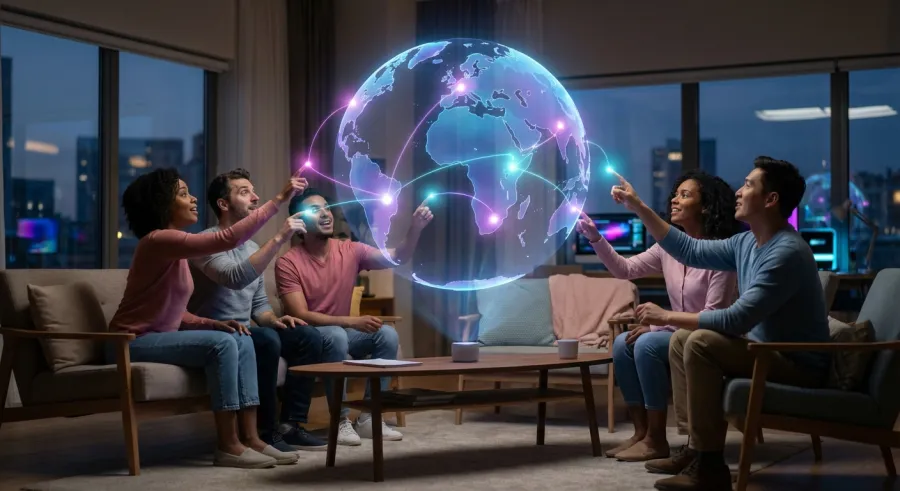
Perhaps the most damaging myth about gaming is that it fosters isolation. The 2025 Power of Play report shatters this misconception entirely. 71% of players report that gaming has helped them meet new people, and 64% use it specifically to stay connected with existing friends and family. In a world where physical "third places" (like community centers and parks) are dwindling, video games have become the new digital town square.
The depth of these connections is significant. 43% of parents in Australia, for instance, report that gaming helps them bond with their children. It bridges the generational divide, providing a shared language and objective. Technology plays a pivotal role here. GPT-4 is currently being deployed to break down language barriers in global servers. Imagine playing a cooperative game with a teammate in Seoul while you are in New York; GPT-4 can translate colloquialisms and strategy in real-time, preserving the nuance that traditional translation tools miss.
Moreover, GPT-4 is revolutionizing community management. Toxicity has long been a plague in online spaces. Advanced LLMs can now detect nuanced harassment or bullying in text and voice chat with far greater accuracy than previous keyword-based filters. This creates safer, more welcoming environments, which encourages the 73% of players who say games help them feel less lonely to engage more openly.
4. The "University of the Controller": Skill Acquisition
The notion that video games are a waste of time is scientifically bankrupt. The report highlights that players perceive tangible growth in critical life skills. 77% agree that games improve creativity, 76% cite improved problem-solving skills, and 74% believe gaming enhances cognitive capabilities. This is "stealth learning"—acquiring complex competencies under the guise of entertainment.
Consider the cognitive load of a modern strategy game. A player must manage resources, predict opponent moves, and adjust logistics in real-time. This is executive function training. With GPT-4, these educational benefits are being amplified. Educational games are moving away from static quizzes to dynamic scenarios. GPT-4 can generate infinite variations of a puzzle or a historical simulation, ensuring that the learner cannot simply memorize the answer but must understand the underlying logic.
Top Skills Cultivated by Gaming:
- Creativity (77%): Players are often creators, building mods, levels, or characters. GPT-4 assists here by acting as a co-pilot, helping players write code or generate lore for their creations.
- Problem Solving (76%): Games require hypothesis testing. You try a strategy, it fails, you iterate.
- Adaptability (72%): Game rules change. Environments shift. Players learn to pivot quickly, a trait highly valued in the modern workforce.
5. Professional Training and the Future of Work
The crossover between gaming and professional development is becoming increasingly blurred. The report indicates that nearly half (50%) of players believe gaming has helped them in their careers. This extends far beyond the e-sports industry. It touches upon medicine, engineering, aviation, and corporate leadership.
In the medical field, the phenomenon of the "Nintendo Surgeon" is well-documented. Surgeons who play video games regularly have demonstrated superior hand-eye coordination and faster reaction times in robotic surgery. Now, medical simulators powered by GPT-4 are pushing this further. These simulators can generate unique patient complications on the fly, forcing medical residents to diagnose and treat unexpected conditions in a safe, virtual environment. The verbal interactions with "patients" in these simulations are driven by GPT-4, providing realistic dialogue that tests a doctor's bedside manner as much as their scalpel skills.

Corporate training is also evolving. Instead of boring slide decks, companies are using "serious games" to train employees in conflict resolution and leadership. GPT-4 enables these role-playing scenarios to be incredibly lifelike. A manager can practice a difficult conversation with an AI employee powered by GPT-4, which can react with anger, sadness, or indifference, providing a robust training ground for emotional intelligence.
6. The Developer's Challenge: Scaling with GPT-4
For the creators of these worlds, the "Power of Play" represents a massive economic opportunity, but also a technological hurdle. Creating the rich, adaptive worlds that players now demand requires immense computational power and sophisticated coding. This is where the utilization of GPT-4 via unified APIs becomes a critical business strategy.
Startups and indie developers often struggle with the "AI barrier." Implementing a model as powerful as GPT-4 to drive NPCs (Non-Player Characters) or generate procedural content can be cost-prohibitive. However, by using smart scheduling and API aggregation services (like those offered by GPT Proto), developers can access GPT-4 at a fraction of the cost. This democratization of technology means that a small team in Poland or Brazil can build a game with the same narrative depth as a massive studio in California.
How GPT-4 is Changing Game Development:
- Infinite Narrative: GPT-4 allows for "unscripted" NPCs. Instead of repeating three lines of dialogue, characters can discuss current in-game events, hold grudges, or form friendships based on player actions.
- Code Generation: GPT-4 acts as a force multiplier for coding, helping developers debug and write boilerplate code faster, allowing them to focus on creative design.
- Personalized Difficulty: GPT-4 analyzes player behavior to adjust game mechanics in real-time, reducing churn and increasing engagement.
Conclusion: The Future is Playful
The 2025 Power of Play report is more than a collection of statistics; it is a validation of a lifestyle. It confirms that the 2.5 billion people who pick up a controller are not checking out of society—they are tuning into a new frequency of human experience. They are building mental muscle, forging global friendships, and preparing for a digital-first future.
As we look toward 2030, the integration of GPT-4 will only deepen these trends. We are moving toward a world where games are personalized teachers, empathetic therapists, and boundless creative canvases. The stereotype of the lonely gamer is gone, replaced by the reality of the connected, resilient, and skilled player.
Whether you are a developer looking to integrate GPT-4 into your next project, or a player looking to understand the value of your hobby, one thing is clear: the power of play is real, and it is transforming the world one interaction at a time.
Original Article by GPT Proto
"We focus on discussing real problems with tech entrepreneurs, enabling some to enter the GenAI era first. With GPT Proto, get up to 60% off mainstream API prices (OpenAI, Claude, Google) and enjoy unified access to Text, Image, and Video models. Write once, integrate all, and scale your gaming or tech startup with smart scheduling today."