Introduction
The race for AI dominance has fundamentally reshaped how developers build intelligent applications. In 2026, choosing the right AI API isn't just about capability—it's about cost efficiency, scalability, and competitive advantage. The market has fractured from "best model" to "best model for your specific need," with pricing dropping 70-90% in just 12 months. Pricing wars erupted when competitors like DeepSeek and Grok challenged OpenAI's dominance, forcing Google and Anthropic to aggressively reprice their offerings. Recent data reveals the competitive breakdown: OpenAI still leads with roughly 50% of production AI API usage, Gemini captures 25-30% through competitive pricing and Google Cloud integration, Claude holds 15-20% through enterprise safety focus, while DeepSeek and Grok split the remaining 5-10% but are growing at 200%+ quarterly rates. Making the wrong API choice costs thousands monthly—a startup selecting expensive OpenAI when DeepSeek fits their needs wastes significant resources, while an enterprise choosing Gemini without understanding Claude's safety advantages creates compliance risks. This guide provides concrete pricing comparisons, market data, and decision frameworks to help you select the API that truly optimizes for your project—not hype or brand recognition.
What Makes the Best API for Developer Projects
Understanding AI APIs starts with grasping how they function. An API serves as a communication bridge between your application and powerful machine learning models hosted on remote servers. You send a request with your input data, and the API returns processed results. This approach gives you access to billions of dollars in research and development without needing expensive hardware or specialized expertise.
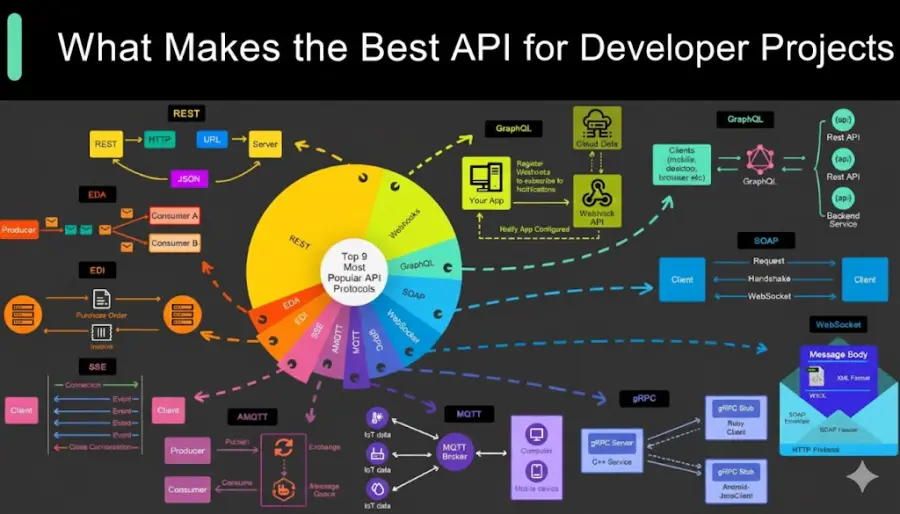
The best API for developers shares several essential characteristics. First, it must offer a genuinely useful free tier that allows real prototyping, not just brief trials. Second, quality matters more than quantity. Access to modern, reliable models from reputable providers ensures your applications deliver consistent results. Third, clear documentation and simple authentication save countless hours of frustration. Finally, room for growth means you won't hit walls when your project gains traction.
Evaluation criteria should include response speed, model variety, pricing transparency, and developer support quality. The right choice depends on your specific needs, whether you're building real-time chat interfaces, processing large volumes of data, or experimenting with cutting-edge capabilities.
Top 10 Best AI API Platforms for Developers
OpenAI API: Industry Standard for Language Models
OpenAI's API remains the most widely adopted platform for building AI applications. The latest GPT-5.2 introduces stronger reasoning, better instruction following, and improved coding performance, making it ideal for production-grade and agent-based systems. The GPT-4.1 model delivers excellent performance on reasoning and coding tasks. For cost-conscious projects, GPT-4o Mini offers 60% lower costs than standard GPT-4o while maintaining strong performance for chatbots and content moderation. GPT-Image-1.5 provides high-quality image generation and editing with strong prompt alignment.
The OpenAI ecosystem includes well-documented APIs, strong community support, extensive library integrations, and a mature platform that handles everything from prototype to production seamlessly.
- Key strengths: Exceptional text quality, robust documentation, high reliability, wide community support
- Key Models: GPT 5.2, GPT-4.1, GPT-4o, GPT-4o Mini, GPT-Image-1.5
- Best for: General-purpose text generation, chatbots, coding assistance, content creation
- Pricing structure: Pay-as-you-go starting at $5 minimum prepaid credits
Google Gemini AI APIs: Comprehensive Multimodal Suite
Google's Gemini API offers exceptional value and native multimodal capabilities. Gemini 3(Nano Banana Pro) introduces stronger reasoning, improved efficiency, and better long-context understanding, making it well-suited for agentic and production AI applications. Gemini 2.5 Pro handles text, images, audio, and video in a single call—no separate API integrations needed. The free Gemini 2.0 Flash tier makes experimentation accessible, while enterprise customers get Gemini Enterprise for $30/user/month with unlimited usage.
One major advantage: Gemini processes up to 1 million token context windows, making it ideal for applications requiring deep document analysis. Google Cloud integration means straightforward deployment, billing, and scaling.
- Key strengths: Generous free limits, multimodal capabilities, excellent documentation, proven scalability
- Key Models: Gemini 3, Gemini 2.5 Pro, Gemini 2.0 Flash (free beta), Gemini 1.5 Flash
- Best for: Multimodal applications, image and video understanding, large document processing
- Pricing structure: Free tier up to 180 million tokens monthly, then usage-based pricing
Anthropic Claude API
Anthropic Claude stands out for safety-first design and extended context windows (200K tokens). The Claude API is particularly strong for enterprise applications where responsible AI practices matter. Recent benchmarks show Claude outperforms alternatives on coding tasks and long-form content generation.
Three model tiers let you optimize costs: Haiku for high-volume, simple tasks; Sonnet for balanced performance; Opus for maximum capability on complex reasoning.
- Core Features: Constitutional AI, safety-focused language processing, vision capabilities
- Key Models: Claude 4.5 Sonnet, Claude 4.5 Opus, Claude 4.5 Haiku
- Best For: Enterprise safety, long-context reasoning, code generation, content analysis
- Pricing: $3 per 1M input tokens (Sonnet); $15 per 1M output tokens
DeepSeek API
DeepSeek disrupted 2025's pricing with 94% lower costs than comparable OpenAI models. Despite the low price, performance remains competitive on reasoning tasks and mathematical problem-solving. The Mixture-of-Experts architecture delivers GPT-4 class performance while consuming fewer computational resources.
- Core Features: Large language model with reasoning capabilities
- Best For: Cost-sensitive projects, mathematical reasoning, scientific analysis
- Pricing: Competitive usage-based pricing
- Key Models: DeepSeek V3, DeepSeek R1, DeepSeek V3.2
Microsoft Azure Cognitive Services: Enterprise-Ready Solutions
Azure provides deep integration with Microsoft's cloud ecosystem. If your application already lives in Azure, using these services provides seamless billing, shared authentication, and simplified infrastructure management. Strong enterprise support and compliance certifications appeal to large organizations.
- Key strengths: Enterprise security, customizable models, hybrid deployment options, Microsoft ecosystem integration
- Key Services: Computer Vision, Language, Speech, Decision
- Best For: Enterprise Azure users, accessibility features, comprehensive suite integration
- Pricing structure: Free tier available, then consumption-based pricing with volume discounts
AWS AI Services: Scalable and Secure Infrastructure
Amazon Web Services provides battle-tested AI tools through services like Amazon Comprehend for text analysis, Rekognition for image processing, and Polly for text-to-speech. The platform's reliability comes from years of supporting massive scale applications across industries.
Security features meet the highest standards, making AWS suitable for sensitive applications in finance and healthcare. The broad service portfolio means developers can find specialized tools for nearly any AI task. Integration with other AWS services creates comprehensive solutions without vendor sprawl.
- Provider: Amazon Web Services
- Key strengths: Proven reliability, comprehensive security, extensive service catalog, seamless AWS integration
- Key Services: SageMaker, Bedrock, Polly, Rekognition
- Best For: Large-scale applications, existing AWS infrastructure, machine learning pipelines
- Pricing structure: Free tier includes limited monthly usage, standard pay-per-use thereafter
OpenRouter: The Multi-Model Marketplace
OpenRouter transforms how developers experiment with different AI models. This platform aggregates dozens of models from various providers under a single API, eliminating the hassle of managing multiple accounts and billing systems. Developers can test Claude 3.5 Sonnet, Llama 3, and Mistral simply by modifying one line of code.
The service shines for comparison testing and finding the optimal model for specific tasks. Many open-source models are available completely free, while proprietary options follow transparent usage-based pricing. This flexibility makes OpenRouter the best API for developers who prioritize experimentation.
- Key strengths: Unified access to multiple models, simple model switching, free open-source options, straightforward pricing
- Best for: Developers wanting to compare models and optimize for specific use cases
- Pricing structure: Free credits at signup, ongoing access to free models, pay-per-use for premium models
Read More: Top OpenRouter Alternatives - Better Pricing & Features
Hugging Face Inference API: Open Source Community Hub
Hugging Face hosts the world's largest collection of open-source machine learning models. Their Inference API provides instant access to thousands of pre-trained models for text generation, classification, translation, and specialized tasks. The vibrant community continuously contributes new models and improvements.
Developers appreciate finding highly specialized models trained on specific datasets. Need sentiment analysis for medical texts or translation for rare language pairs? Chances are someone has already created and shared a suitable model. The platform eliminates the need to download, configure, and host models yourself.
- Key strengths: Massive model selection, active community, specialized models, free access to public models
- Access: 200,000+ pre-trained models
- Best For: Research, prototyping, specialized NLP tasks, open-source models
- Pricing structure: Free API access to public models with rate limits, paid tiers for higher throughput
Groq: Speed-Optimized Infrastructure
Groq took a hardware-first approach, building custom Language Processing Units designed specifically for running large language models. The result is the fastest response times available, often delivering results in under 300 milliseconds. This speed advantage makes Groq the best API for developers creating real-time conversational experiences.
The platform supports popular open-source models like Llama 3 and Mistral while maintaining OpenAI API compatibility. This compatibility means existing code often works with minimal changes. The generous free tier provides ample room for development and testing before scaling.
- Key strengths: Exceptional speed, OpenAI compatibility, generous free tier, real-time performance
- Best for: Chat applications, virtual assistants, and any project where response latency matters
- Pricing structure: Generous free tier with high rate limits, usage-based pricing for production
Stability AI: Leading Image Generation Platform
Stability AI revolutionized AI-generated imagery with Stable Diffusion. Their API enables developers to create unique, high-resolution images from text descriptions. The technology powers applications ranging from game asset creation to marketing material generation.
Recent improvements expanded capabilities beyond simple image generation. Developers can now perform image-to-image transformations, upscaling, and style transfers. The open-source foundation encourages experimentation and custom modifications. Batch processing features make it efficient for creating large volumes of visual content.
- Key strengths: High-quality image generation, flexible modification options, open-source foundation, batch processing
- Best for: Creative applications, game development, marketing automation, and digital art tools
- Pricing structure: Free tier available for testing, subscription plans for production use
AssemblyAI: Professional Speech Recognition
AssemblyAI specializes in speech-to-text with built-in intelligence features. Beyond basic transcription, the platform detects topics discussed, analyzes sentiment, redacts personally identifiable information, and handles multiple speakers. Real-time processing enables live transcription for meetings and broadcasts.
- Key Features: Real-time transcription, topic detection, sentiment analysis
- Best For: Audio transcription, real-time transcription, audio intelligence
- Pricing structure: Transparent pay-per-use based on audio hours processed
Cohere: Enterprise Natural Language Processing
Cohere delivers advanced language understanding tailored for business applications. Their models excel at semantic search, text classification, and content generation with customization options that adapt to specific industry terminology. Enterprise customers appreciate the platform's focus on data privacy and model control.
The API provides fine-tuning capabilities allowing developers to train models on proprietary data without sharing sensitive information. This approach maintains performance advantages while respecting confidentiality requirements. Cohere's consulting services help teams optimize implementations for maximum value.
- Key strengths: Customizable models, strong data privacy, enterprise support, semantic understanding
- Best for: Business applications requiring domain-specific language understanding
- Pricing structure: Pay-as-you-go with volume discounts, custom enterprise agreements available
Black Forest Labs FLUX API
FLUX represents a major leap in image generation quality and consistency. FLUX API is developed by Black Forest Labs, FLUX.1 Schnell balances speed and visual fidelity, producing professional-grade images in seconds, while FLUX.1 Pro targets maximum quality and prompt accuracy. FLUX Kontext adds context-aware image understanding and editing, enabling more precise control, better scene consistency, and iterative visual workflows. FLUX is especially valued for stable style output and strong prompt adherence.
- Provider: Black Forest Labs
- Key Models: FLUX Kontext Pro, FLUX Kontext Max, FLUX.1 Schnell, FLUX.1 Pro
- Key Features: Real-time transcription, topic detection, sentiment analysis
- Best For: High-quality image generation, creative projects, design automation
- Pricing Model: Usage-based pricing
Tavus API
Tavus excels in creating personalized video content, making it perfect for marketing teams and businesses looking to scale video production.
- Provider: Tavus
- Core Features: AI video generation and personalization
- Best Use Cases: Marketing campaigns, personalized video content, onboarding
- Pricing Model: Subscription-based
- Unique Selling Points: Tavus API, powered by the Phoenix model, is a top API that significantly simplifies video production, embedding advanced text-to-speech capabilities directly into applications.
Comparing Best API Features and Pricing
| Platform |
Best Use Case |
Free Tier |
Starting Price |
Key Advantage |
| OpenAI API |
General-purpose AI, chatbots, code generation |
❌ No true free tier |
$5 minimum prepaid credits |
Best-in-class text quality and ecosystem maturity |
| Google Gemini API |
Multimodal apps, large document analysis |
✅ Yes (up to 180M tokens/month) |
Free, then usage-based |
Native multimodal + 1M token context |
| Anthropic Claude API |
Enterprise AI, long-context reasoning |
❌ Limited / no free tier |
$3 per 1M input tokens |
Safety-first design and 200K context |
| DeepSeek API |
Cost-sensitive reasoning & math tasks |
❌ No public free tier |
Usage-based (very low cost) |
Up to 94% cheaper than GPT-4-class models |
| Azure Cognitive Services |
Enterprise Azure-native applications |
✅ Yes (limited quotas) |
Usage-based |
Enterprise security and Azure integration |
| AWS AI Services |
Large-scale, secure AI workloads |
✅ Yes (limited monthly usage) |
Pay-per-use |
Proven scalability and security |
| OpenRouter |
Model comparison & experimentation |
✅ Yes (free credits + free models) |
Pay-per-use |
One API for dozens of AI models |
| Hugging Face Inference API |
Research & specialized NLP models |
✅ Yes (public models, rate-limited) |
Free → paid tiers |
Largest open-source model ecosystem |
| Groq API |
Real-time chat & low-latency AI |
✅ Yes (generous limits) |
Usage-based |
Fastest inference (<300ms latency) |
| Stability AI API |
Image generation & creative tools |
✅ Yes (testing tier) |
Subscription-based |
High-quality image generation (Stable Diffusion) |
| AssemblyAI |
Speech-to-text & audio intelligence |
❌ No free tier |
Pay-per-audio-hour |
Advanced transcription & audio analysis |
| Cohere API |
Enterprise NLP & semantic search |
❌ No free tier |
Usage-based |
Strong data privacy & customization |
| FLUX API (Black Forest Labs) |
High-end image generation |
❌ No free tier |
Usage-based |
Consistent, professional-grade image quality |
Choosing the Best API for Developer Needs
Selecting the right platform requires matching your project requirements to each provider's strengths. Start by defining your primary use case. Building a customer service chatbot differs significantly from creating an image editing tool or transcribing podcasts.
Budget considerations play a crucial role, especially for side projects and startups. Platforms offering substantial free tiers like Google Cloud AI or Groq allow extended testing without financial pressure. Remember that free limits eventually constrain growth, so understand upgrade paths before committing.
Technical requirements matter just as much as features. Real-time applications demand low latency, making Groq or OpenRouter better choices than batch-optimized platforms. Projects handling sensitive data need providers with strong security credentials like Azure or AWS. Consider whether you need simple REST APIs or prefer comprehensive SDKs in your programming language.
Development velocity improves with good documentation and active communities. Struggling with unclear guides wastes valuable time. Check whether providers offer code examples in your preferred language and responsive support channels. The best API for developers combines powerful features with smooth implementation experiences.
- Choose OpenAI if you need: proven reliability, excellent coding performance, strong community support, or general-purpose capability.
- Choose Gemini if you need: multimodal understanding, long context processing, cost efficiency, or Google Cloud integration.
- Choose Claude if you need: maximum safety assurance, long-context analysis, coding excellence, or enterprise compliance.
- Choose DeepSeek if you need: absolute lowest cost, strong reasoning performance, or cost-sensitive scaling.
- Choose Specialized APIs if you need: video generation, real-time transcription, image synthesis, or domain-specific capabilities.
- Best Practice: Evaluate your top 2–3 choices with real data from your application. One hour of testing prevents months of regret.
Emerging Trends Shaping AI APIs in 2026
Multimodal Integration Becomes Standard
The best APIs now handle text, images, audio, and video in a single call. This trend eliminates the need to juggle multiple API integrations and reduces total latency. Applications feel more natural when AI understands context across media types simultaneously.
Video and Image Generation Advances
Video generation tools like Kling 2.5, Google Veo 3, and Runway Gen-2 now create cinematic, 1080p quality clips up to 2 minutes long. Image generation quality has reached professional standards. These capabilities are no longer novelties—they're production-ready for marketing, education, and entertainment applications.
Specialized APIs for Specific Industries
Healthcare APIs handle HIPAA compliance. Financial APIs understand regulatory requirements. Legal APIs process contracts. These specialized platforms prevent teams from building compliance infrastructure around generic models.
Real-Time and Edge Processing
Latency requirements continue dropping. Real-time transcription, live video processing, and instant image generation now work on consumer hardware. This trend enables interactive AI features that were impossible just months ago.
Pricing Compression Through Competition
2025 saw a dramatic race to the bottom on pricing. New entrants like Grok forced incumbents to offer lower rates. Gemini's free tier and aggressive pricing created pressure across the market. This competition benefits developers and businesses immensely—you're no longer locked into expensive options by default.
GPT Proto: Your Budget-Friendly AI API Solution
Managing multiple AI APIs creates unnecessary complexity. Developers juggle different authentication systems, separate billing accounts, inconsistent documentation, and fragmented integrations. GPT Proto solves this problem by unifying access to the world's best AI models through a single, developer-friendly platform.
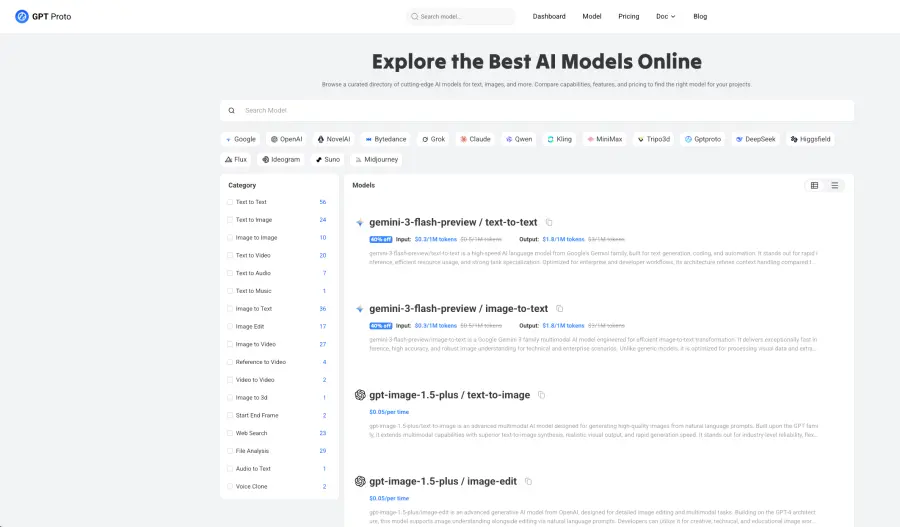
Instead of integrating OpenAI, Gemini, Claude, and specialized services separately, GPT Proto handles the infrastructure. You get one API key, one dashboard, one set of documentation—with access to dozens of models.
Key Capabilities:
- Access to 50+ AI models including OpenAI GPT, Claude, Gemini, Grok, Midjourney, Runway, Ideogram, FLUX, Kling
- Unified pricing with transparent, per-token billing across all models
- Clean, well-documented REST APIs built for seamless integration with any programming language or framework
- Global, high-performance infrastructure ensuring fast responses from anywhere in the world
- Automatic load balancing and fallback routing for maximum reliability
|
Feature
|
Direct APIs
|
GPT Proto
|
|
API Keys Required
|
One per provider (10+)
|
One unified key
|
|
Documentation
|
Multiple sources to navigate
|
Single, comprehensive guide
|
|
Billing Accounts
|
Separate invoices per provider
|
One consolidated bill
|
|
Integration Time
|
Hours per API
|
Minutes for all APIs
|
|
Model Selection
|
Limited to one provider
|
50+ models, any time
|
|
Pricing Optimization
|
Manual comparison
|
Automatic best-rate routing
|
|
Authentication
|
Different schemes per API
|
Consistent authentication
|
|
Support
|
Fragmented across vendors
|
Unified support team
|
The setup process takes minutes, not days:
- Create an account on GPT Proto dashboard with your email
- Generate an API key from the settings panel—no complex verification required
- Review documentation with code examples in Python, JavaScript, Node.js, and more
- Make your first API call to any model—from OpenAI's GPT-4 to FLUX image generation
- Monitor usage in real-time with detailed analytics and cost breakdowns
Real-World Integration Example with GPT Proto
Deploy a multi-model application without architectural complexity:
Single GPT Proto Integration:
├── Text Generation (OpenAI GPT)
├── Image Creation (FLUX)
├── Video Generation (Runway)

vs.

Multiple Direct APIs:
├── OpenAI account → authentication → documentation
├── Black Forest Labs account → authentication → documentation
├── Runway account → authentication → documentation
Pricing Structure
GPT Proto uses transparent, usage-based pricing matching the underlying model costs. You pay for what you use—nothing more.
Popular scenarios:
- Small project: 1,000 API calls/month = ~$5–15 depending on model selection
- Growing startup: 100,000 API calls/month = ~$200–500 range
- Enterprise: Custom pricing with dedicated support and volume discounts
Compare this against managing multiple accounts separately: platform support costs, billing overhead, and integration maintenance add hidden expenses that GPT Proto eliminates.
Conclusion
The 2026 AI API market is mature, competitive, and accessible—the days of "one best API for everything" have ended. Success now requires matching budget constraints, capability requirements, and integration speed to specific platforms. Start with your budget constraint, not brand preference: a $5,000/month budget eliminates cost-focused options like DeepSeek, while a $500/month budget makes OpenAI impractical and shifts focus to Gemini or Claude. Next, match capability requirements to actual use cases—text-only applications don't need multimodal APIs, simple chatbots waste money on premium models like Claude Opus, and video generation demands specialized APIs like Runway or Kling, not general-purpose LLMs. Teams that optimize API selection today gain 3-6 month lead times on competitors still overspending on misaligned tools; the difference between DeepSeek ($14/month) and OpenAI ($140/month) at scale funds additional engineering capacity and translates to longer runway for startups. Finally, prioritize integration speed through platforms like GPT Proto that reduce deployment time by 70-80% compared to managing multiple direct APIs. Pick your top 2-3 candidate APIs, allocate 2-3 hours for hands-on testing with your actual use cases, measure output quality and cost simultaneously, and document results—this single afternoon prevents months of regret and saves thousands in unnecessary infrastructure costs. The tools are accessible, the data is available, and the time to build is now.