What Is Nano Banana Pro?
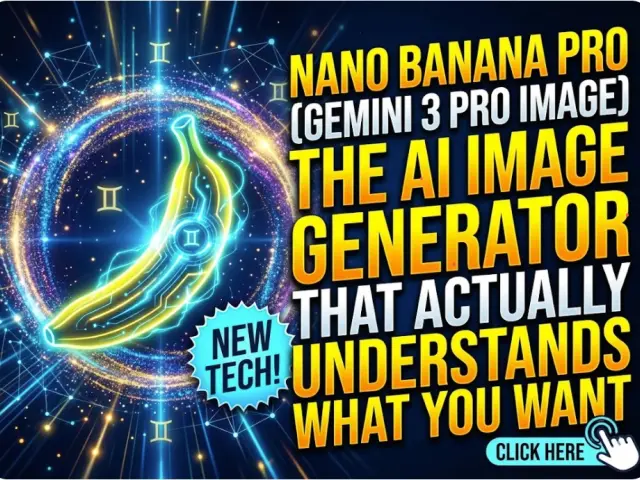
Nano Banana Pro is Google's most advanced image generation model, built on Gemini 3 Pro's reasoning foundation. The "Nano Banana" name originated from Logan Kilpatrick's cryptic banana emoji tweets, which the community embraced as a playful way to distinguish model versions.
Core Innovation: The model understands context before rendering pixels. When generating water pouring between glasses, it comprehends gravity, fluid dynamics, and splash patterns—not just visual patterns.
As Google states, it "helps you visualize any idea and design anything—from prototypes, to infographics, to turning handwritten notes into diagrams."
Nano Banana Pro transforms image generation from pattern matching to intelligent visual problem-solving through genuine AI reasoning.
Nano Banana Pro Features: 3 Professional Advantages Over Standard Models
-
Unprecedented Control
High Resolution Output
| Feature |
Original Nano Banana |
Nano Banana Pro |
| Resolution |
~1024×1024 pixels |
Native 4K (3840×2160) |
| Visual Data |
Standard density |
8× more information |
| Print Quality |
Digital only |
Commercial printing ready |
Enhanced Consistency
-
Blend up to 14 reference images into single compositions
-
Maintain consistency of 5 different people simultaneously
-
Understand complex context: lighting, materials, structure
-
Transform sketches into production designs or blueprints into 3D structures
Creative Control
-
Local region editing: Precise area fine-tuning
-
Camera angle switching: Instant perspective changes
-
Focus adjustment: Narrative-driven emphasis
-
Color grading: Cinematic atmosphere control
-
Lighting transformation: Daytime to nighttime, hard to soft light
These controls elevate Nano Banana Pro to a visual engine supporting directorial-grade creative work.
-
Perfect Text Rendering
Text Quality Evolution
| Aspect |
Original |
Pro Version |
| Edge Quality |
Smudging, soft |
Sharp, clean |
| Character Structure |
Distorted |
Proper weight |
| Multi-language |
Inconsistent |
Professional-grade |
Multi-Language Support:
-
Chinese: Proper stroke structure and composition
-
English: Maintained kerning and alignment
-
Japanese, Korean, French, etc.: Stable high-quality rendering
Advanced Capability: Translate and localize content while maintaining visual style—like translating English text on beverage cans to Korean while preserving font style and positioning.
Multi-language text competence enables international marketing without separate regional adaptations.
-
Advanced World Knowledge
Real-Time Google Search Integration
| Traditional Workflow |
Nano Banana Pro |
| Research → Design → Refine |
Single prompt → Complete visual |
The model connects to live web content for:
-
Current weather, sports scores, events
-
Geographic and temporal accuracy
-
Factual information in infographics
-
Automatic presentation generation from text
Testing Example: Weather visualization for Hangzhou generated accurate temperature (8°C), correct date (Nov 21), seasonal autumn scenery, and geographically correct West Lake imagery.
Real-time information collapses multi-step workflows into single prompt execution.
Nano Banana Pro Performance: Real-World Image Generation Tests
Physics and Material Mastery
Water Pouring Test (4-Frame):
-
Frame 1: Precise 45° tilt, proper trajectory
-
Frame 2: Realistic collision splash with accurate vectors
-
Frame 3: Rising level with ripples and bubbles
-
Frame 4: Final state with correct volume
Demonstrates understanding of gravitational acceleration, fluid dynamics, and surface tension—not pattern copying.
Food Typography: Created Chinese characters from hot pot ingredients with accurate textures, natural bundling, and realistic stacking.
LEGO Rendering: Generated Doraemon figure with individual brick studs visible, proper assembly seams, and legible display case text: "LEGO x Doraemon Limited Edition 125/500."
Physics accuracy and material understanding eliminate weeks of 3D simulation or expensive photography sessions.
Product and Scene Generation
Bluetooth Speaker - Dual Scenes:
Maintained perfect product consistency across:
-
Camping scene: Tent interior, campfire glow, coffee cup
-
Tech showcase: Suspended mid-air, floating notes, dramatic spotlight
Material Transformation (Doraemon Panel):
Four styles from identical composition:
-
Original manga with line art
-
Clay/plasticine with soft edges
-
Bronze sculpture with patina
-
LEGO bricks with proper studs
Scene switching and material transformation enable unlimited product presentations without proportional time investment.
Using Nano Banana Pro for Business: Marketing & Creative Applications
Startup Growth Infographic:
-
Timeline showing 18-month progression
-
Team growth (2→25 people) with funding rounds
-
Product evolution (MVP→V3.0)
-
Metrics (users 0→100K, revenue 0→500K)
System understood growth patterns—team expansion correlating with funding, product iterations aligning with user growth.
Hand-Drawn Coffee Shop (Beijing Alleyway):
Watercolor scene with Chinese text:
-
Menu prices with natural handwriting and proper strokes
-
Ink density variation mimicking brush work
-
Unified calligraphic style throughout
Business logic and narrative comprehension enable automatic structuring according to story flow, while native text integration eliminates post-processing.
Validation by International Creators
Max Woolf's Skeleton Pancake: 3D skull-shaped pancake with syrup following bone contours—pooling in eye sockets, flowing around convex surfaces realistically.
Simon Willison's Detection Test: Generated raccoons stealing packages, then tested detection. Gemini correctly identified "25-50% SynthID detected"—accurately reflecting that only raccoons were AI-generated, not background.
Extreme physics tests validate genuine understanding, while accurate detection provides practical protection against deceptive content.
Nano Banana Pro SynthID: AI Watermarking and Image Verification
SynthID Watermarking
-
Invisible digital signature on every image
-
User verification: Upload image, ask "Was this AI-generated?"
-
20+ billion pieces watermarked since 2023
-
C2PA metadata embedded for industry standard compliance
Professional Flexibility: Ultra subscribers can remove visible watermarks for commercial use, but invisible SynthID remains.
Transparency mechanisms enable verification while allowing legitimate creative applications.
How to Access Nano Banana Pro: Pricing, Plans & API Integration
Consumer and Education
| User Type |
Access Level |
| Free Users |
Limited quota, then reverts to original |
| AI Plus/Pro/Ultra |
Higher usage limits |
| AI Mode (Search) |
Pro/Ultra (US only) |
| NotebookLM |
Subscribers globally |
Professional Platforms
-
Google Ads: Asset Studio integration
-
Google Workspace: Slides and Vids
-
Adobe Firefly, Photoshop, Figma, Canva: Direct integration
Developer Solutions
API Access:
| GPT Proto Benefit |
Description |
| Simplified Workflow |
Same API format for multiple models |
| Flexible Pricing |
Pay-per-use transparency |
| Quick Setup |
Account → Credits → API key → Start |
Multi-platform access ensures appropriate entry points for every user type and budget.
Nano Banana Pro vs Nano Banana: Speed and Quality Comparison Guide
| Metric |
Original |
Pro |
| Generation Time |
5-10 sec |
20-40 sec |
| API Cost |
Lower |
3-5× higher |
| Resolution |
~1024px |
Native 4K |
| Text Rendering |
Basic |
Multi-language professional |
| Reasoning |
Pattern matching |
Genuine AI reasoning |
| Real-time Data |
❌ |
✅ Google Search |
Decision Framework
Use Original When: Speed priority, concept exploration, casual projects, budget constraints
Use Pro When: Professional output, text-heavy/multilingual content, print/commercial use, current data needed, physics accuracy essential
Strategic model selection based on requirements maximizes efficiency and quality.
Limitations and Considerations
Known Weaknesses
Visual Issues:
-
Small faces may show inconsistencies
-
Fine details sometimes lack precision
-
Multi-image blending can show artifacts
Text and Data:
-
Precise spelling unreliable in some contexts
-
Complex infographic data may contain errors
-
Factual information requires verification
Responsible Use
-
System refuses inappropriate/offensive requests
-
Not for professional advice (medical, legal, financial)
-
Always disclose AI-generated content in appropriate contexts
-
Verify factual information before publication
Understanding limitations guides users toward appropriate applications and necessary verification procedures.
Conclusion
Nano Banana Pro fundamentally shifts AI image generation from pattern matching to reasoning-driven creation. With native 4K output, professional multi-language text, physics-based understanding, and real-time Google Search integration, it removes barriers preventing professional adoption. The technology excels where earlier generators struggled—consistency, readable multilingual text, spatial relationships, and complex instruction accuracy. While slower and costlier than its predecessor, the reasoning capability, commercial print quality, and workflow integration justify investment for serious creators. As AI tools advance, the constraint shifts from technical capability to human imagination—Nano Banana Pro proves clearly described visions can now execute with remarkable precision and speed.