Gemini 3 Pro Pricing: Complete Cost Guide
Learn Gemini 3 Pro cost and pricing: $2-$4 per million input tokens, $12-$18 output tokens. Get 40% off with GPT Proto.

The Evolution of Google's AI Architecture
Google recently unveiled a massive upgrade to its artificial intelligence ecosystem, capturing the attention of the global tech community. At the center of this technological leap is Gemini 3 Pro, a model designed to bridge the gap between high-end reasoning and enterprise cost efficiency. Developers worldwide are eagerly testing its capabilities to see how it handles complex computational tasks. You need to understand how Gemini 3 Pro operates beneath the surface to truly grasp its unique value proposition.
The architecture powering Gemini 3 Pro represents a massive leap in multimodal processing and logical reasoning. Unlike older iterations that relied entirely on text, Gemini 3 Pro processes visual, auditory, and textual data through a unified neural network. This native multimodal approach allows Gemini 3 Pro to interpret complex scenarios much closer to how a human brain processes environmental stimuli. Building applications with Gemini 3 Pro unlocks entirely new product categories for forward-thinking developers.
Early benchmarks indicate that Gemini 3 Pro drastically outperforms its predecessors in coding, mathematics, and creative problem-solving. Businesses looking to automate complex backend processes are naturally gravitating toward the Gemini 3 Pro infrastructure. However, deploying advanced AI at an enterprise scale requires careful financial planning. Predicting your baseline Gemini 3 Pro expenditure ensures your software projects remain economically viable over the long term.
Decoding the Gemini 3 Pro Pricing Model
Budgeting for API consumption requires a deep understanding of token economics and data processing metrics. The Gemini 3 Pro pricing model utilizes a dynamic, tiered approach based entirely on your specific context window size. This means your operational expenses for Gemini 3 Pro scale directly with the complexity and length of your system prompts.
Google splits the billing for Gemini 3 Pro into two distinct categories to accommodate entirely different usage scales. If your application processes standard conversational data, you will likely stay within the highly affordable baseline tier. However, analyzing massive document dumps or heavy codebases pushes your Gemini 3 Pro usage into the premium computation bracket.

Costs for Contexts Under 200,000 Tokens
Most standard consumer applications will operate comfortably within this primary processing tier. When your combined prompt and system instructions remain under 200,000 tokens, Gemini 3 Pro offers incredibly competitive market rates. You will pay exactly $2.00 for every one million input tokens you send to the Gemini 3 Pro servers.
The output generation naturally carries a much higher computational burden for the server infrastructure. For responses generated by Gemini 3 Pro in this lower tier, expect to pay $12.00 per million tokens. This pricing ratio heavily favors Gemini 3 Pro applications that require reading large amounts of data but only need brief, synthesized answers.
Costs for Contexts Exceeding 200,000 Tokens
Enterprise users often need to process entire software codebases or lengthy legal manuscripts in a single API call. Once your prompt exceeds the 200K threshold, the computational demands on Gemini 3 Pro increase exponentially. Google adjusts the Gemini 3 Pro pricing at this stage to reflect this intensive resource utilization.
In this extended context tier, the input cost for Gemini 3 Pro doubles strictly to $4.00 per million tokens. The output pricing for Gemini 3 Pro also experiences a significant bump, rising sharply to $18.00 per million tokens. You must carefully weigh the necessity of massive context windows against these increased Gemini 3 Pro operational expenses.
Understanding Token Economics for Gemini 3 Pro
To accurately forecast your Gemini 3 Pro budget, you must first understand exactly what a token represents in machine learning. Tokens are not individual words; rather, they are the basic building blocks of text that Gemini 3 Pro digests. A single token usually equates to about four characters of text, or roughly three-quarters of a standard English word.
When you feed a standard one-page document into Gemini 3 Pro, you are typically transmitting around 500 to 600 tokens. Complex formatting, special characters, and non-English languages can alter the token count that Gemini 3 Pro registers. Developers must actively monitor their Gemini 3 Pro token consumption to avoid unexpected spikes in their monthly cloud billing.
Let us look at a practical calculation for a standard Gemini 3 Pro API request. Imagine sending a 2,000-token prompt to Gemini 3 Pro and receiving a detailed 1,000-token response. Using the baseline tier, your input costs $0.004 while your output costs $0.012, bringing the total Gemini 3 Pro transaction to roughly $0.016.
Real-World Cost Estimates for Gemini 3 Pro
Theoretical pricing tables only tell half the story when deploying large language models into production environments. Examining practical use cases helps illuminate how Gemini 3 Pro pricing behaves under actual user load. Different software architectures will interact with the Gemini 3 Pro API in vastly different ways.
Building a Customer Support Chatbot
Customer service bots typically handle short, rapid-fire conversations that consume very little individual context. A standard user query sent to Gemini 3 Pro might only contain 150 tokens of conversation history. The Gemini 3 Pro response is usually equally brief, keeping the transaction well within the cheapest pricing tier.
If your customer support platform processes 10,000 conversations daily using Gemini 3 Pro, your costs remain highly manageable. Assuming 500 input tokens and 200 output tokens per interaction, your daily Gemini 3 Pro expenditure would hover around $10 to $15. This makes Gemini 3 Pro an incredibly cost-effective solution for frontline customer engagement routing.
Developing an AI Content Generator
Content generation tools flip the typical API consumption ratio entirely upside down. When using Gemini 3 Pro to write blog posts or marketing copy, your inputs are usually short instructions. However, the Gemini 3 Pro outputs are massive, generating thousands of tokens per request.
Because Gemini 3 Pro output tokens cost six times more than input tokens, text generation apps require careful monetization strategies. Generating a 2,000-word article with Gemini 3 Pro will cost roughly $0.03 to $0.05 per piece. Software founders must ensure their user subscription fees adequately cover these heavy Gemini 3 Pro output expenses.
Enterprise Data Analysis and Processing
Financial institutions and legal firms frequently leverage the massive 2-million token context window of Gemini 3 Pro. Feeding an entire company's quarterly financial history into Gemini 3 Pro triggers the expensive premium tier immediately. The sheer volume of input tokens drives up the base cost of every single analytical query.
A single massive request sending 1.5 million tokens to Gemini 3 Pro will cost $6.00 just for the input reading. If Gemini 3 Pro then generates a comprehensive 5,000-token summary, the total API call sits around $6.10. While this sounds expensive for a single Gemini 3 Pro query, it is drastically cheaper than paying a human analyst to read 3,000 pages of text.
Comparative Market Analysis: Gemini 3 Pro vs. Competitors
Understanding where Gemini 3 Pro sits in the broader AI marketplace is vital for technical decision-makers. Developers constantly weigh the capabilities of Gemini 3 Pro against other industry heavyweights to find the best value. Let us explore how Gemini 3 Pro stacks up against its closest enterprise rivals.
When compared to OpenAI's flagship models, Gemini 3 Pro offers a highly competitive input pricing structure. While competitors often charge up to $5.00 per million input tokens, the baseline $2.00 rate of Gemini 3 Pro provides significant savings. This makes Gemini 3 Pro highly attractive for RAG (Retrieval-Augmented Generation) applications that require processing vast knowledge bases.
Against Anthropic's Claude family, Gemini 3 Pro holds its own regarding massive context handling and speed. Claude models are renowned for their nuanced reasoning, but Gemini 3 Pro matches this with superior native multimodal integration. For teams relying heavily on Google Cloud infrastructure, staying within the Gemini 3 Pro ecosystem provides unmatched deployment synergy.
Even within Google's own lineup, developers must choose between Gemini 3 Pro and the lighter Gemini Flash models. The Flash variants are explicitly designed for hyper-fast, low-cost operations where deep reasoning is not required. However, when your application demands complex logical deductions, stepping up to Gemini 3 Pro justifies the increased API expenditure.
Multimodal Features: Beyond Text Processing
The true power of Gemini 3 Pro lies far beyond its ability to generate standard text responses. As a natively multimodal system, Gemini 3 Pro can seamlessly ingest and analyze images, audio streams, and video files. These advanced processing capabilities introduce entirely new pricing variables into your Gemini 3 Pro budget calculations.
Image Generation and Processing Expenses
When you feed an image into Gemini 3 Pro for analysis, the API converts that visual data into a static token count. A standard high-resolution image processed by Gemini 3 Pro usually registers as several hundred tokens against your quota. If your application analyzes thousands of user-uploaded photos daily, these Gemini 3 Pro visual token costs will accumulate rapidly.
Gemini 3 Pro also boasts impressive native text-to-image generation capabilities within its broader ecosystem. Creating new images via the Gemini 3 Pro API generally incurs a flat fee per generated image rather than using token math. You must consult the latest Google billing documentation to track exact Gemini 3 Pro image generation rates, as they fluctuate frequently.
Analyzing Video and Audio Feeds
Processing video content represents the most intensive use case for the Gemini 3 Pro architecture. When you upload a video, Gemini 3 Pro essentially breaks the file down into hundreds of sequential image frames and audio chunks. A one-minute video analyzed by Gemini 3 Pro can easily consume tens of thousands of tokens from your context window.
Audio processing with Gemini 3 Pro follows a similar token-conversion logic based on the length of the sound file. Transcribing or analyzing voice notes through Gemini 3 Pro is incredibly accurate but requires monitoring your input volume. Developers building voice-first applications with Gemini 3 Pro should implement aggressive audio compression to minimize token bloat.
Strategies to Reduce Your Gemini 3 Pro Costs
Smart engineering teams do not simply accept high API bills as an unavoidable cost of doing business. There are numerous architectural strategies you can implement to drastically lower your monthly Gemini 3 Pro expenditure. Optimizing how your software communicates with Gemini 3 Pro requires continuous refinement and testing.
Mastering prompt engineering is the most immediate way to cut your Gemini 3 Pro usage costs. By making your instructions concise, you stop feeding unnecessary input tokens into the Gemini 3 Pro context window. Every extraneous word you remove from your system prompt saves fractions of a cent that compound massively over millions of Gemini 3 Pro API calls.
Implementing aggressive output length constraints is another vital tactic for managing your Gemini 3 Pro budget. Because Gemini 3 Pro output tokens are expensive, you should use parameters like 'max_tokens' to prevent runaway generation. Forcing Gemini 3 Pro to answer in bullet points or JSON formats inherently limits the expensive output characters.
Context caching is a revolutionary feature that can slash your Gemini 3 Pro enterprise bills dramatically. If you repeatedly send the same massive document to Gemini 3 Pro across multiple user sessions, you can cache that input. Instead of paying the full input token price every time, Gemini 3 Pro charges a fraction of the cost to recall the cached data.
The Secret to Discounted Gemini 3 Pro Access: GPT Proto
For independent developers and lean startups seeking more affordable access to cutting-edge AI, alternative routing platforms provide incredible value. GPT Proto has emerged as a premier API provider for teams looking to slash their Gemini 3 Pro expenses. This platform specializes in delivering highly stable, heavily discounted access to the entire Google Gemini ecosystem.
Rather than negotiating custom enterprise contracts directly with Google, you can route your traffic through GPT Proto instantly. They aggregate massive API volumes to secure wholesale pricing, passing those Gemini 3 Pro savings directly down to the developer. Using GPT Proto allows you to build powerful Gemini 3 Pro applications without draining your startup runway.
How Much Can You Save on Gemini 3 Pro?
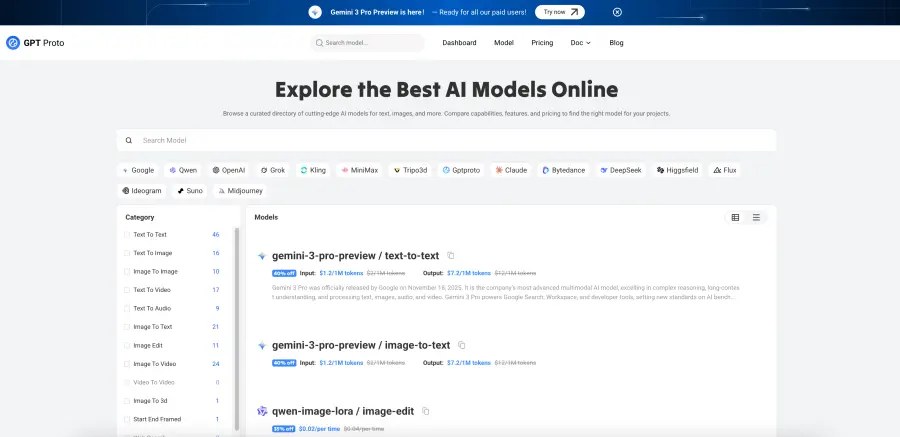
The financial advantage of routing your AI traffic through GPT Proto is immediately apparent on your first billing cycle. The platform offers an extraordinary 40% blanket discount on standard Gemini 3 Pro token costs. This massive cost reduction applies equally to both your Gemini 3 Pro input queries and output generations.
With this routing discount, your Gemini 3 Pro input cost drops from $2.00 down to just $1.20 per million tokens. Similarly, the expensive Gemini 3 Pro output tokens fall from $12.00 to a highly manageable $7.20 per million. For an application processing billions of tokens monthly, shifting your Gemini 3 Pro API calls to GPT Proto saves thousands of dollars.
Seamless API Integration for Gemini 3 Pro
Migrating your existing applications to take advantage of these discounted Gemini 3 Pro rates requires almost zero technical effort. GPT Proto is designed specifically to act as a drop-in replacement for standard AI endpoints. You simply update your API base URL and swap in your new authentication keys to continue using Gemini 3 Pro.
The platform also provides unified access to multiple versions of the model, including Gemini 3 Pro Text-to-Image and Gemini 2.5 Flash. This allows developers to route complex tasks to Gemini 3 Pro while sending simpler tasks to cheaper models automatically. Managing all your AI routing through one centralized dashboard makes scaling your Gemini 3 Pro integration remarkably straightforward.
Is Gemini 3 Pro Worth the Investment?
Determining the true return on investment for Gemini 3 Pro requires looking beyond the raw token pricing. You must evaluate the tangible business value generated by Gemini 3 Pro's advanced reasoning capabilities. For many companies, the automation power of Gemini 3 Pro far outweighs the monthly API expenditures.
If Gemini 3 Pro can successfully automate tasks that previously required expensive human labor, the token costs become trivial. A legal tech firm using Gemini 3 Pro to review contracts in seconds creates immense leverage for their human attorneys. In these high-value scenarios, paying $18.00 per million output tokens for Gemini 3 Pro is a spectacular business bargain.
Conversely, if you are building a free consumer application with no monetization strategy, Gemini 3 Pro might quickly bankrupt your project. Developers must align their Gemini 3 Pro utilization with strong revenue-generating features. Matching the power of Gemini 3 Pro to the right business model ensures sustainable, profitable software growth.
Forecasting the Future of AI API Costs
The landscape of artificial intelligence pricing is incredibly volatile and subject to rapid downward pressure. As Google continues to optimize its underlying data centers, the operational costs of running Gemini 3 Pro will naturally decrease. Historically, major API providers slash their prices every few months to maintain competitive dominance.
It is highly likely that the base token costs for Gemini 3 Pro will drop significantly within the next year. Furthermore, the introduction of specialized Gemini 3 Pro routing models will give developers even finer control over their compute expenses. Staying agile and continuously monitoring Gemini 3 Pro documentation ensures you always leverage the best available rates.
Whether you interface directly with Google Cloud or utilize cost-saving platforms like GPT Proto, Gemini 3 Pro remains a formidable tool. By mastering token optimization and understanding the tiered pricing models, you can harness Gemini 3 Pro without breaking the bank. The developers who effectively manage their Gemini 3 Pro budgets today will build the most sustainable AI companies of tomorrow.
References
-
Google AI: Gemini API Pricing Documentation: https://ai.google.dev/gemini-api/docs/pricing
-
Reddit: Gemini 3 Pro First Impressions: https://www.reddit.com/r/singularity/comments/1p0f6uw/gemini_3_pro_first_impressions/
Grace: Desktop Automator
Grace handles all desktop operations and parallel tasks via GPTProto to drastically boost your efficiency.
Start Creating