TL;DR
Veo 4, unconfirmed for release, is expected mid-2026 with multi-minute video generation, advanced physics, and cinematic camera controls. Currently, Veo 3.1 leads in visual quality while Sora 2 excels in motion realism.
What's next for Google's AI video generator? Explore Veo 4 predictions, expected release date (likely May 2026), features, and how it compares to Sora 2 and Kling.
Veo 4, unconfirmed for release, is expected mid-2026 with multi-minute video generation, advanced physics, and cinematic camera controls. Currently, Veo 3.1 leads in visual quality while Sora 2 excels in motion realism.
Google's Veo series has quietly reshaped what AI video generation can accomplish. In May 2024, Veo arrived as a proof-of-concept. By October 2025, Veo 3.1 was delivering 4K video with native synchronized audio—something many thought impossible months earlier. Meanwhile, OpenAI's Sora 2 (released September 2025) raised the bar on physics realism, and Kling 2.6 brought native audio to action-heavy content at significantly lower cost. But where's Veo 4? As of January 2026, Google hasn't officially announced it. Yet industry watchers and reliable sources suggest a mid-2026 release could reshape professional video creation once more. This guide separates confirmed facts from educated predictions, so you can make informed decisions today—and know how to access Veo 4 when it arrives.
This is the most likely scenario. Google historically announces major AI updates at its annual developer conference. May 2026 would give Google a full year post-Veo 3.1 to develop meaningfully improved capabilities. It would also position Veo 4 as a major press moment to counter OpenAI's competitive advances.
If internal testing reveals critical gaps or if competitors (OpenAI, Kuaishou) accelerate their own releases, Google might announce Veo 4 at a special event or via a surprise blog post. This is less likely but possible if competitive pressure intensifies.
Most important caveat: No official date or feature list exists. All predictions are based on release patterns, industry trends, and unverified leaks. Google could surprise everyone—or delay indefinitely—without public announcement.
The AI video space has reached a critical inflection point. Every major competitor—Google, OpenAI, and Kuaishou—now supports native audio generation. This wasn't expected six months ago; now it's table stakes. The differentiation has shifted to motion physics, character consistency, and video length.
Veo 3.1 leads in cinematic visual polish and prompt faithfulness. Sora 2 excels at physics-driven scenes and longer clips (up to 25 seconds). Kling 2.6 dominates action sequences and motion control with competitive pricing. Each model has carved a distinct niche, which means Veo 4's success depends on where Google can deliver the most meaningful innovation.
Yet there's another critical consideration most creators overlook: how you access these tools matters as much as the tools themselves. When major platforms change ownership, priorities shift, pricing becomes unpredictable, and feature roadmaps can abandon developers who built on them. Stable, multi-model platforms that support diverse AI ecosystems provide insulation against these disruptions.
No official announcement exists, so everything below is educated prediction based on Google's research trajectory and industry benchmarks. However, these aren't random speculations—they're informed by what Google DeepMind, NVIDIA, and other AI researchers have publicly demonstrated.
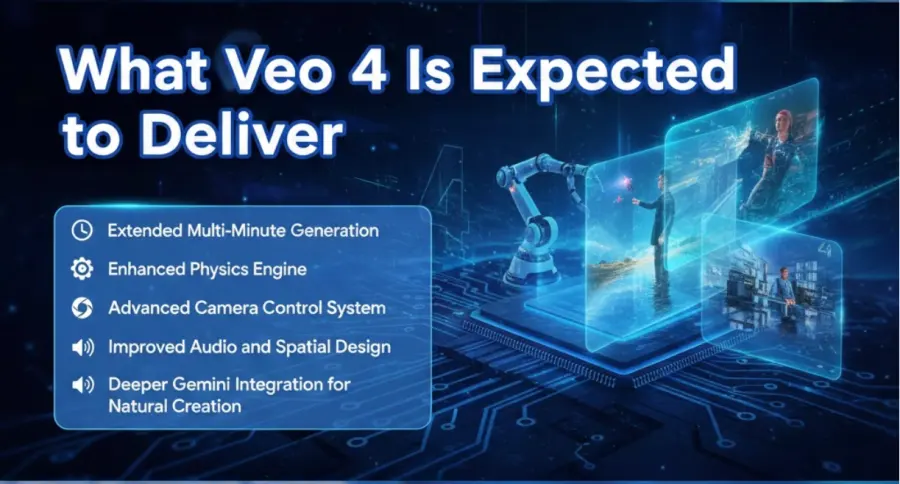
The single biggest request from Veo users: longer, coherent videos. Veo 3.1 caps at 8 seconds. Sora 2 reaches 25 seconds. NVIDIA demonstrated 1-minute consistent videos in laboratory settings in 2024, proving the technology exists. Veo 4 is likely to support 30-60 seconds per generation—or potentially longer with story-arc understanding.
This alone would make Veo 4 suitable for short-form storytelling, product demonstrations, educational content, and narrative-driven work that currently requires stitching multiple Veo 3.1 clips together through manual editing.
Veo 3.1's most obvious gap versus Sora 2: motion physics in complex scenarios. Veo 4 is expected to include advanced capabilities across multiple domains:
Realistic fluid dynamics for water surfaces, smoke, and fire behavior
Accurate cloth simulation and fabric movement with realistic draping
Natural hair interaction with wind, gravity, and movement
Improved light reflection, refraction, and shadow tracking
Better handling of collision physics and object-to-object interactions
These improvements would position Veo 4 as the first choice for product videos, action sequences, and cinematic storytelling where physical accuracy directly impacts viewer credibility.
Modern filmmaking language relies on precise camera movement. Veo 4 is rumored to support cinematic camera techniques that currently require manual specification:
Dolly zoom effects (subject remains centered while background moves, creating psychological tension)
Crane shots and smooth vertical movement across scenes
Steadicam-style tracking that follows subjects without visible jitter
Dynamic focus shifts and depth-of-field changes between subjects
Automatic shot sequencing optimized for emotional impact
Instead of describing every camera detail in prompts, creators could specify intent—"tense confrontation," "peaceful morning," "triumphant reveal"—and Veo 4 would automatically employ appropriate framing, movement, and pacing.
Veo 3.1's audio generation is functional but remains basic compared to Sora 2's integration capabilities. Veo 4 is expected to advance to:
3D spatial audio where sound position matches visual locations on screen
Directional audio that shifts as the virtual camera moves through space
Multiple voice options with consistent vocal characteristics across scenes
Emotional tone matching in dialogue delivery (anger, joy, sadness, fear)
Advanced ambient soundscape generation with layered environmental audio
For creators wearing quality headphones, a footstep approaching from behind would sound directional, or a character's voice would originate precisely from their screen location.
Google's core competitive advantage is language understanding. Veo 4 is likely to be tightly integrated with Gemini, enabling workflows that blend conversation with creation:
Conversational video creation: Describe your vision naturally in Gemini, and it optimizes your prompts for Veo 4
Intelligent iteration: Gemini analyzes your video output and suggests specific improvements aligned with your goals
Multi-step workflows: Script generation → storyboarding → video production → editing suggestions all in one conversation
Content understanding: Gemini analyzes existing footage and helps extend or modify it using Veo 4's capabilities
This integration would make Veo 4 accessible to non-technical creators while providing power users sophisticated control through natural language.
Tips: A comparison table between Sora 2, Veo 3.1 and Kling 2.6
| Feature | Sora 2 | Veo 3.1 | Kling 2.6 |
| Max Video Length | 25 seconds | 8 seconds (extendable to 60s) | 10 seconds (extendable) |
| Resolution | 1080p | 4K | 1080p |
| Native Audio | ✓ Excellent | ✓ Native synchronized | ✓ New in 2.6 |
| Physics Realism | Superior | Good | Excellent |
| Character Consistency | Strong | Excellent (reference images) | Excellent (single character) |
| Motion Control | Limited | Moderate (editing tools) | Superior (Motion Control) |
| Pricing (Standard) | $0.10-0.50/sec | $0.20-0.40/sec (Veo 3.1) | ~$0.35/video |
| Previous Version | N/A | Veo 3: $0.18-0.35/sec | N/A |
| Global Access | US/Canada only | Broad availability | Broad availability |
| Best For | Physics-driven realism | Advertising, cinematic quality | Action, motion, budget-conscious |
Tips: Learn more about Veo 3 pricing and how to use Veo 3 here.
When Veo 4 launches, access method matters as much as the model itself. Here's why independent aggregation AI API platforms like GPT Proto represent the smarter long-term choice compared to relying on single-provider APIs.

GPT Proto supports Veo 4 immediately upon launch and will maintain stability regardless of Google's internal restructuring. Here's how:
Rapid Model Support: GPT Proto successfully integrated DeepSeek v4 and all previous DeepSeek versions in record time, demonstrating its ability to add major models as they release. Veo 4 will follow the same pattern—support within days or weeks of availability.
Pricing Transparency: Rather than being subject to Google's pricing changes, GPT Proto aggregates multiple providers and guarantees competitive rates through volume optimization. If Google raises prices, GPT Proto can balance load across compatible alternatives.
Feature Continuity: When major platforms discontinue features, GPT Proto maintains support through multiple provider options. You're never locked into a single roadmap.
Unified Integration: Instead of managing separate API keys and authentication for Veo 3.1, Sora 2, and Kling 2.6, GPT Proto provides single-platform access to all competitive video models. Your integration code scales as new models launch.
Version Management: As Veo 4 evolves to Veo 4.1, 4.2, etc., GPT Proto maintains support for multiple versions simultaneously, letting you test backwards compatibility and migrate at your own pace.
Veo 4 represents the natural next step in Google DeepMind's video generation journey. Longer videos, better physics, advanced camera control, and deeper Gemini integration are all reasonable expectations based on industry progress and Google's research capabilities. But here's the practical reality: Veo 4 isn't confirmed, and creation timelines matter right now. If your projects need professional video today, Veo 3.1, Sora 2, and Kling 2.6 deliver production-ready results immediately. If you have runway and need a paradigm shift—multi-minute videos, sophisticated physics, Hollywood-grade camera work—then waiting for Veo 4 makes strategic sense. The AI video space is no longer debating "will this work?" Instead, the question is "which tool fits my specific need, timeline, and budget?" Veo 4 will be powerful. But the best AI video generator is the one that exists when you need it. When Veo 4 arrives, accessing it through stable AI API platforms like GPT Proto ensures you're not locked into a single provider's roadmap changes. Start preparing now, and you'll be ready to leverage Veo 4's capabilities the moment Google makes the official announcement.
Generate images and videos here. The GPTProto API ensures fast model updates and the lowest prices.
Start Creating