xAI Grok API Pricing 2026: What You Need to Know Before You Start
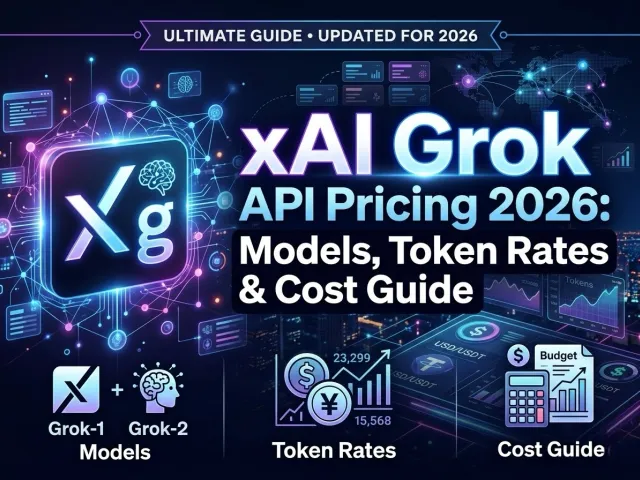
If you're building an app, running automated workflows, or just trying to figure out which AI model fits your budget, xAI Grok API pricing is one of the most talked-about topics in the developer community right now. In early 2026, xAI's Grok models grabbed attention after claiming the top spot on LMArena's benchmark leaderboard — beating out GPT and Claude on several key metrics. At the same time, Grok's parent company continues to burn through roughly $1 billion a month on infrastructure, raising questions about long-term pricing stability. For developers, this makes understanding the xAI Grok API pricing 2026 landscape more important than ever.
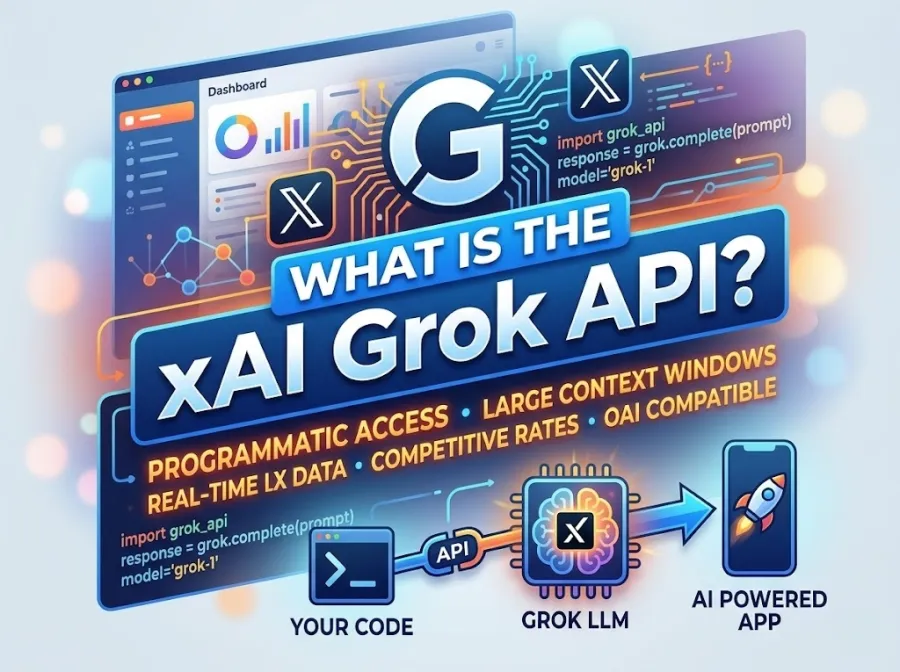
What Is the xAI Grok API?
The Grok API gives developers programmatic access to xAI's family of large language models. Instead of chatting through a website, you send requests directly from your code, and the model sends back a response. This is the standard way to build AI into apps, customer tools, or automation pipelines.
What makes Grok stand out is a combination of unusually large context windows (up to 2 million tokens on some models), real-time access to data from X (formerly Twitter), and competitive per-token rates. The API is compatible with OpenAI's format, which means developers who already use GPT can switch to Grok with minimal changes to their code.
xAI Grok API Pricing in 2026: A Complete Breakdown
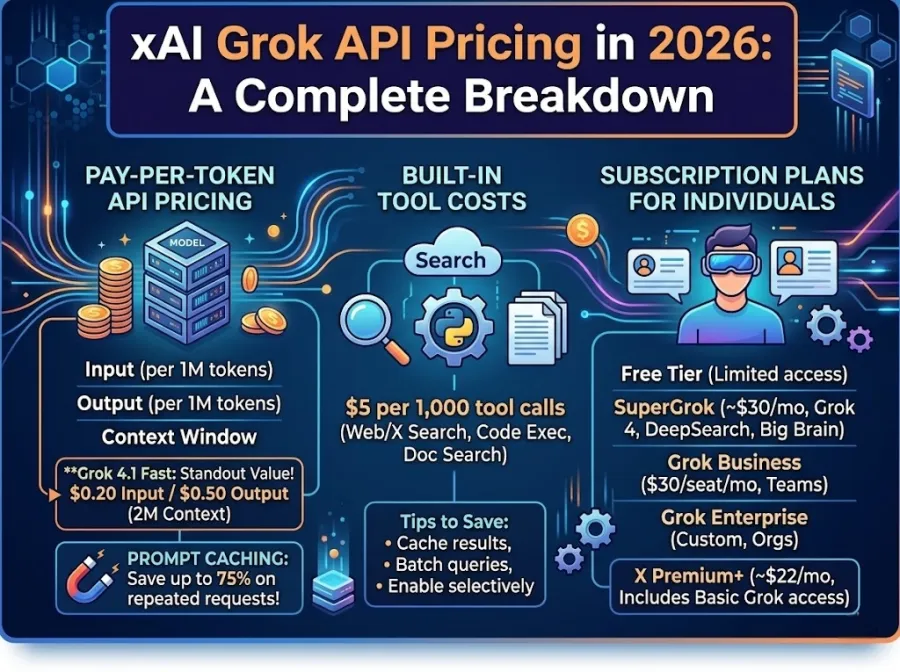
Understanding xAI Grok API pricing requires looking at three separate layers: the per-token cost of the model you use, the cost of any built-in tools you call, and the subscription options for individual users. Here is how each of those breaks down.
Pay-Per-Token API Pricing
When you use the Grok API, you pay separately for input tokens (what you send) and output tokens (what the model generates). Output tokens are typically more expensive because they take more computing power to produce.
As of March 2026, the verified xAI Grok API pricing is:
ModelInput (per 1M tokens)Output (per 1M tokens)Context WindowGrok 4.1 Fast$0.20$0.502,000,000Grok Code Fast$0.20$1.502,000,000Grok 3 Mini$0.30$0.50131,072Grok 3$3.00$15.00131,072Grok 4$3.00$15.00256,000Grok 2 Vision$2.00$10.0032,768
For most general-purpose use cases, Grok 4.1 Fast is the standout value. It scores very close to Grok 4 on quality benchmarks but costs roughly 15 times less per token. Unless your project demands the absolute highest level of reasoning accuracy, starting with Grok 4.1 Fast makes financial sense.
One important detail: xAI automatically applies prompt caching on repeated requests. Cached input tokens on Grok 4.1 Fast drop to just $0.05 per million, and Grok 4's cached rate falls to $0.75 per million. If your application reuses the same system prompt or context frequently, this alone can cut costs by 50% to 75%.
Built-In Tool Costs
Grok's API includes several built-in tools you can call directly, such as web search, X search, code execution, and document search. These are charged separately from token usage, at $5 per 1,000 tool calls. That is an easy cost to overlook when planning a budget. If your app calls a search tool on every user request, those fees can add up quickly.
To keep tool costs manageable:
-
Cache search results when the same query is likely to repeat
-
Batch related queries into one tool call where possible
-
Only enable tools your application actually needs
Subscription Plans for Individual Users
Not every Grok user needs API access. xAI also offers flat-rate subscription plans for people who want to use Grok through a chat interface rather than code:
-
Free tier: Limited access, good for testing before committing
-
SuperGrok: Approximately $30 per month, includes Grok 4, DeepSearch, Big Brain Mode (extended reasoning), and expanded image generation via Imagine 1.0
-
Grok Business: $30 per seat per month, designed for teams
-
Grok Enterprise: Custom pricing, intended for large organizations with compliance needs
Note: X Premium+ ($22/month) also includes basic Grok access, which is a low-cost way to try the model before investing in API credits.
How xAI Grok API Pricing Compares to Other AI Providers
One of the biggest reasons developers are looking at xAI Grok API pricing 2026 is cost. Here is a side-by-side look at how Grok stacks up against its main rivals at the time of writing:
Provider & ModelInput (per 1M tokens)Output (per 1M tokens)Grok 4.1 Fast$0.20$0.50Grok 4$3.00$15.00GPT-5 Mini~$0.75~$3.00Claude Sonnet 4.6$3.00$15.00Claude Opus 4.6$5.00$25.00Gemini 3.1 Pro$2.00$12.00
Grok 4.1 Fast is cheaper per token than every comparable model in this table. The trade-off is that xAI is a newer company with a smaller developer ecosystem and shorter enterprise track record. For teams where pricing sensitivity is high, that trade-off is often worth it. For teams where stability, support, and long-term vendor confidence matter more, it is worth weighing carefully.
It is also worth noting that Grok's 2-million-token context window is the largest available from any provider at this price point. That is a practical advantage for tasks like document analysis, large codebase review, or long multi-turn conversations.
How to Get Started with the Grok API and Keep Costs Low
Getting access to the Grok API takes just a few steps:
-
Create an account at console.x.ai
-
Navigate to Billing and add prepaid credits, or enable monthly invoiced billing
-
Go to API Keys, click "Create Key," and copy it immediately (it is only shown once)
-
Set a spending limit in the console to avoid unexpected charges
New users currently receive $25 in free promotional credits on signup. Beyond that, xAI offers an additional $150 per month in credits through their data sharing program, which allows xAI to use your API interactions to improve future models. For non-sensitive projects like development testing or public-facing tools, this is a generous option.
To keep ongoing costs as low as possible:
-
Use Grok 4.1 Fast as your default, and only call Grok 4 for tasks where precision is critical
-
Enable prompt caching by front-loading static content (system prompts, reference documents) in your requests
-
Use the batch API for non-real-time tasks — it offers a 50% discount on all token types
A Simpler Way to Access Grok Through GPT Proto AI API Platform
Managing API keys across multiple AI providers can get messy fast. If your project uses more than one model, tracking separate billing, rate limits, and API formats is a real overhead. That is where a unified API platform like GPT Proto becomes useful.
GPT Proto is an all-in-one API aggregation platform that provides access to leading AI models, including Grok, through a single endpoint. Rather than maintaining separate accounts with xAI, OpenAI, Anthropic, and Google, developers can integrate once and switch between models as needed. The platform uses pay-as-you-go pricing with no monthly subscription required.
For Grok specifically, GPT Proto offers access to the Grok Imagine image generation model at $0.012 per image, which is 40% below the standard market rate of $0.02. This makes it a practical option for developers who want to use Grok's image generation capabilities without paying full retail.
If you want to explore what Grok 4 can do before committing to direct xAI API access, GPT Proto's model library is a good starting point. You can also find a detailed overview of Grok 4's capabilities, benchmarks, and use cases in the GPT Proto blog guide to Grok 4.
FAQs
Q: What is the cheapest Grok model to use via API in 2026?
Grok 4.1 Fast is currently the most affordable option, priced at $0.20 per million input tokens and $0.50 per million output tokens. It also supports a 2-million-token context window, which makes it genuinely competitive even compared to more expensive models.
Q: Is there a free tier for the xAI Grok API?
New accounts receive $25 in promotional credits at signup. xAI also offers $150 per month in additional credits through a data sharing program. The free chat tier on the X platform is another way to test Grok without API costs, though it has usage limits.
Q: How does xAI Grok API pricing in 2026 differ from what it was in 2025?
The current Grok 4 and 4.1 model lineup represents a major shift from the earlier Grok 2 and Grok 3 generations. Token rates have become more competitive, context windows have expanded dramatically (from 32K to 2M tokens), and new models like Grok Code Fast have been added to serve specific developer needs. The pricing has moved more aggressively toward volume-based discounts through caching and the batch API.
Q: Are there any hidden costs I should know about with the Grok API?
Yes, the most commonly overlooked cost is the built-in tool fee. Web search, X search, code execution, and document search each cost $5 per 1,000 calls on top of your token usage. If your application calls these tools frequently, this can become a significant line item in your bill. Always factor tool calls into your cost estimates before going live.
Conclusion
The xAI Grok API pricing 2026 story is one of genuine opportunity for cost-conscious developers. Grok 4.1 Fast delivers near-frontier performance at a fraction of what competing models charge, and the 2-million-token context window adds real practical value. That said, no pricing decision should ignore the full picture: tool fees, data sharing trade-offs, and a younger ecosystem all deserve weight. Whether you access Grok directly through xAI's console or through a unified platform like GPT Proto AI API Provider, understanding these details up front is what separates a project that scales cleanly from one that hits surprises mid-deployment.