
Is the current tech boom a bubble or the beginning of a new economic era? A comprehensive analysis of 40 years of financial data suggests the latter, predicting that Generative AI is on a trajectory to unlock a staggering $20 trillion market by 2032. By examining the cyclical nature of the PC, Internet, and Mobile revolutions, researchers have identified a recurring 'Rule of 3' in value creation. This report dissects why the infrastructure phase we see today is merely the prelude to a massive application-driven wealth transfer.
2026-02-28
Generative AI Forecast: Inside the $20 Trillion Market Shift
Explore the hidden patterns in 40 years of financial data that predict AI will become a $20 trillion market by 2032. Learn why the application layer is the biggest untapped opportunity and how current infrastructure giants like Nvidia are just the beginning of a massive economic shift.
Table of contents
The $20 Trillion Echo: How 40 Years of Data Predicts the Future of Generative AI
In the high-stakes environment of Silicon Valley boardrooms and Wall Street trading floors, one question dominates every strategic conversation: What is the true value of Generative AI? For some skeptics, the current frenzy resembles the dot-com bubble of 2000—a burst of speculative energy destined to collapse. For proponents, it marks the dawn of a Second Industrial Revolution.
However, the truth is likely found not in opinions, but in cold, hard historical data. A landmark longitudinal study by the Fundrise Innovation Fund has analyzed over four decades of financial performance across 250 tech giants. The findings reveal a hidden rhythm to technological progress—a mathematical consistency that suggests Generative AI is not just another trend, but a $20 trillion tectonic shift that is only just beginning.
Dissecting the Methodology: A 40-Year Lens
To forecast the economic impact of Generative AI, we must first understand the architecture of the past. The research underlying this forecast is exhaustive, tracking every public technology company with a market capitalization exceeding $1 billion between 1980 and 2024. By leveraging Bloomberg data and proprietary financial modeling, analysts did not merely track stock prices; they deconstructed market capitalization into specific layers of the tech stack: Hardware, Platforms, and Applications.
Take Microsoft as a prime example. In the 1990s, its valuation was derived from the PC platform (Windows) and productivity applications (Office). Decades later, that same corporate entity dominates the Cloud platform (Azure) and Cloud applications (SaaS). By mapping revenue streams for titans like Amazon, Apple, Nvidia, and Cisco, the study reconstructed the "allocated market cap" for every major technological epoch. The result is not random noise, but a clear, repeating signal.
"Generative AI, while revolutionary, acts as the latest progression in a consistent series of technology waves. To predict our destination, we simply need to analyze the geometry of our history."
The Rule of 3: Exponential Market Expansion
The most profound insight from this dataset is the "Michael Moritz Corollary," named after the legendary Sequoia Capital partner. The data indicates that each successive technological wave generates a market capitalization roughly three times larger than its predecessor.
Consider the historical progression of value creation:
- The PC Wave (peaking ~1995): Generated approximately $186 billion in market value.
- The Internet Wave (peaking ~2012): Surged to $646 billion, a 3.5x increase.
- The Mobile Wave (peaking ~1995): Reached $2.16 trillion, a 3.4x increase.
- The Cloud Wave (forecasted peak ~2025): Currently valued at $6.5 trillion, exactly a 3.0x multiplier.
This is the "Rule of 3" in motion. If Generative AI adheres to this established trajectory, the implied market value upon maturity around 2032 is a colossal $21.16 trillion. This figure isn't a hopeful guess; it is the mathematical output of a cycle that has repeated with precision since the 1980s.

Moore’s Law: The Economic Engine of Generative AI
What drives this consistent tripling of value? The research identifies a causal link to Moore’s Law. For decades, the biannual doubling of transistor counts has acted as the industry's pacemaker. The study concludes that a 10x increase in compute power consistently unlocks an innovation cycle resulting in a 3x increase in market capitalization.
In the 1990s, the leap from tens of millions to hundreds of millions of transistors birthed the consumer Internet. In the 2010s, moving from millions to billions gave us the smartphone ecosystem. Each order-of-magnitude jump in processing power creates the fertile ground necessary for new business models. With Generative AI, we are witnessing a compute acceleration that might make even the $20 trillion estimate conservative.
The 25/25/50 Split: Anatomy of a Tech Wave
While the total pie grows larger, the way the slices are cut remains surprisingly stable. The research categorizes the tech stack into three layers:
- Hardware: The physical infrastructure (semiconductors, servers, data centers).
- Platforms: The operating systems and middleware enabling software execution.
- Applications: The end-user interfaces solving specific human or business problems.
Over forty years, value distribution has averaged 25% for Hardware, 26% for Platforms, and 48% for Applications. This historical average is critical for investors looking at Generative AI today. In the early stages of any wave, hardware leads. You cannot deploy software without the underlying silicon. This explains Nvidia’s ascent to a $3 trillion valuation; they are providing the steel for the AI age. However, history dictates that nearly half of the long-term value will eventually migrate to the Application layer.
The $10.5 Trillion Application Gap
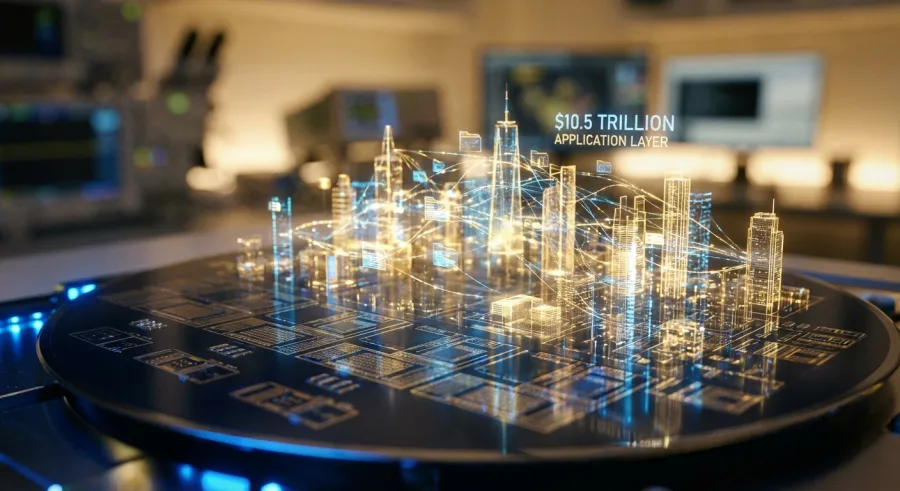
Applying the 48% historical average to the projected $21 trillion Generative AI market implies that AI Applications will eventually be worth $10.5 trillion. Currently, the market is nowhere near this figure. While infrastructure giants like Nvidia are fully valued, and platform players like OpenAI are maturing, the application layer remains nascent.
This "Application Gap" represents perhaps the largest untapped investment opportunity of the modern era. We are firmly in the infrastructure build-out phase. Just as Cisco was the titan of the 1990s for building web routers, Nvidia dominates today for building LLM accelerators. But the enduring wealth of the Internet wasn't captured by router manufacturers; it was captured by the applications built on top of them—Amazon, Google, and Meta.
For founders and developers, the mandate is clear: The next decade isn't about integrating a simple AI feature; it's about building definitive Generative AI applications that dominate entire verticals. The shift from raw compute to integrated value is where the next generation of trillion-dollar entities will emerge.
Navigating the Integration Bottleneck
As the market transitions from Hardware to Platforms and Applications, complexity spikes. In the Mobile era, developers chose between iOS and Android. The Generative AI landscape is far more fragmented, forcing developers to navigate a maze of Large Language Models (LLMs), varying pricing structures, and complex API requirements.
This fragmentation creates a need for Unified Integration. To capture a share of the $10.5 trillion application value, companies must strictly manage their API-heavy cost structures. The "official" pricing for top-tier model access can decimate margins for scaling startups.
This reality drives the adoption of middleware infrastructure like GPT Proto. By providing a unified integration layer that supports Official, OpenAI, and GPT Proto formats simultaneously, it empowers developers to switch models without refactoring code. Crucially, it solves the cost efficiency equation, offering API access at approximately 60% of official rates. As Generative AI matures into its application phase, the ability to leverage intelligent scheduling and resource optimization will separate profitable giants from failed experiments.
The Oligarchy of Tech: Winner-Take-All Dynamics
The 40-year dataset offers a stark warning: Technology markets are oligarchies, not democracies. The study analyzed the top three winners in each layer of every historical wave. The concentration of power is immense:
- Platform Layer: The top three companies capture an average of 98% of total value.
- Hardware Layer: The top three capture 85%.
- Application Layer: The top three capture 67%.
In the PC era, Microsoft and Apple held the platform monopoly. In Internet hardware, Cisco and Juniper reigned supreme. The Generative AI wave mirrors this, with Nvidia dominating hardware and a fierce battle unfolding between OpenAI, Google, and Meta for platform dominance. The Application layer, while still exhibiting winner-take-all characteristics, offers the widest lane for new entrants, with 33% of value distributed outside the top three. This is where the "Blue Ocean" opportunity lies.
Huang’s Law: The Acceleration Factor
The forecasts discussed assume Generative AI follows the "Rule of 3" tied to Moore’s Law. However, there is a disrupting variable: Huang’s Law. Named after Nvidia CEO Jensen Huang, this observation notes that GPU performance for AI is advancing at twice the speed of Moore’s Law. While CPUs saw 10x gains over several years, Nvidia is delivering 1000x performance leaps in a decade.
If a 10x compute increase yields a 3x market cap expansion, what happens when compute scales by 100x or 1000x? Researchers suggest we are moving from linear scaling to hyper-scaling. Under this new paradigm, the Generative AI wave could theoretically see a 6x market cap increase, pushing potential value from $20 trillion to upwards of $40 trillion.
Preparing for the $20 Trillion Dawn
The financial history of the last four decades tells a story of relentless, predictable expansion. We stand today at the foot of the Generative AI adoption curve—comparable to the Internet in 1995 or Mobile in 2010. The Hardware phase is maturing, the Platform phase is crystallizing, but the Application phase is an open frontier.
For those building the future, the strategy is threefold:
- Target the Application Layer: Shift focus from infrastructure to the end-user value where 50% of the market capitalization will eventually reside.
- Prioritize Efficiency: As the market matures, margin management becomes paramount. Utilizing tools like the GPT Proto dashboard for resource allocation and the usage analytics to track performance will be essential for survival.
- Aim for Dominance: Understanding the winner-take-all nature of tech means aiming for the top three spots in your niche is not ambition—it is a requirement for relevance.
The $20 trillion Generative AI opportunity is the inevitable echo of forty years of history. The race to define the next era of the global economy is underway, and the data suggests the biggest winners are yet to be crowned.
Grace: Desktop Automator
Grace handles all desktop operations and parallel tasks via GPTProto to drastically boost your efficiency.
Start Creating
Related Models

claude-opus-4-8-thinking/text-to-text
Claude Opus 4.8 Thinking is Anthropic's most advanced model, featuring deep reasoning blocks for complex logic. Use Claude for high-accuracy coding, agentic workflows, and 200k context tasks via our high-performance API at GPTProto.com.
$ 20
20% off
Market: $ 25
claude-opus-4-8-thinking/web-search
Claude Opus 4.8 Thinking API is Anthropic's premier model for complex logic and agentic tasks. With a 200k context window and internal reasoning blocks, it delivers high-accuracy coding and nuanced data analysis for enterprise-grade solutions.
$ 20
20% off
Market: $ 25
claude-opus-4-8-thinking/file-analysis
ai claude opus 4.8 thinking is Anthropic's pinnacle reasoning model. Featuring a 200,000 token context window and specialized thinking blocks, it masters complex coding, legal analysis, and agentic workflows with unmatched logical precision.
$ 20
20% off
Market: $ 25
claude-opus-4-8/text-to-text
Claude Opus 4.8 offers top-tier reasoning and long-context handling. Use Claude for deep research or complex coding tasks. Opus 4.8 integrates via our unified API for reliable performance and easy scaling across diverse AI applications.
$ 20
20% off
Market: $ 25