Why Claude Code is the New Inflection Point
Technology moves in waves that often go unnoticed until they crash onto the shore. We saw it with the web, with mobile, and recently with chatbots. But a new shift is happening right in the terminal of our computers.
Right now, approximately 4% of all public commits on GitHub are authored by a single tool: Claude Code. This isn't just a minor helper or a autocomplete plugin. It represents a fundamental shift in how we build the world.
By the end of 2026, experts predict that Claude Code will be responsible for over 20% of all daily code commits. While the general public was watching AI generate pretty pictures, AI consumed the core of software development.
This tool isn't just another chatbot stuck in a side panel. It is a terminal-native agent that operates with a level of autonomy we haven't seen before. It marks the transition from "talking to AI" to "working with agents."
To understand why Claude Code is causing such a stir, we have to look past the syntax. We have to look at how intelligence is being organized. This is the moment where software becomes more like living intelligence.

Defining the Power of Claude Code
So, what exactly is Claude Code? Unlike tools like Cursor that focus on a visual editor, this is a Command Line Interface (CLI) tool. It lives where the most serious engineering work happens: the terminal.
Claude Code reads your entire codebase, plans out complex multi-step tasks, and then executes them. It doesn't just suggest a line of code. It understands the environment, the file system, and the intended outcome of the user.
Think of it as a "Claude Computer" rather than just a coding assistant. It has full access to your machine's capabilities. It can run tests, debug errors, and iterate on a plan until the goal is achieved.
The user provides a high-level objective in natural language. Instead of worrying about implementation details, the human provides direction. Claude Code handles the heavy lifting of writing, verifying, and refining the actual code blocks.
It is the best current example of an AI Agent in the wild. It doesn't just respond to a prompt. It acts on the world. This represents a glimpse into a future where all computing is agentic.
"Claude Code is the first real proof point that agents can handle the complexity of modern software engineering without constant hand-holding."
The Rise of Vibe Coding with Claude Code
A new term has emerged in the developer community: "vibe coding." Coined by Andrej Karpathy, it describes a shift where engineers spend more time managing the "vibe" or intent than writing syntax.
With Claude Code, the ability to write code manually is starting to atrophy for many top-tier engineers. This sounds scary, but it’s actually a natural evolution of the craft. We moved from assembly to C++, and now to agents.
Malte Ubl, the CTO of Vercel, recently noted that his primary job has shifted. He no longer focuses on the lines of code. Instead, his job is now to tell the AI what it did wrong.
Ryan Dahl, the creator of NodeJS, has gone even further. He suggests that the era of humans writing raw code is essentially over. Claude Code is the primary engine driving this specific cultural and technical realization.
Even legendary figures like Linus Torvalds are seeing the shift. The way we interact with computers has fundamentally changed from manual labor to high-level orchestration. Claude Code is the conductor of this new orchestra.
| Feature |
Traditional Coding |
Claude Code Workflow |
| Primary Input |
Manual Syntax |
Natural Language Intent |
| Error Handling |
Manual Debugging |
Autonomous Loop/Verification |
| Context Awareness |
Developer's Memory |
Full Codebase Ingestion |
| Speed |
Linear (Human Speed) |
Exponential (Agentic Speed) |
The Economic Impact of Claude Code
The rise of Claude Code isn't just a win for developers. It is a massive financial engine for Anthropic. It is driving exceptional revenue growth that may allow the lab to outgrow competitors like OpenAI.
Every commit made by Claude Code represents tokens being consumed. As the tool moves from 4% to 20% of GitHub, the revenue implications are staggering. This is a "killer app\" that generates recurring value.
We are seeing a detailed economic shift. More compute capacity now directly translates to more revenue. Anthropic is adding more revenue every month than almost any other AI lab, largely thanks to Claude Code adoption.
This growth is currently only constrained by the availability of chips and data centers. As more power comes online, the scale of Claude Code will only increase. It is the crown jewel of their product lineup.
For enterprises, the ROI is impossible to ignore. A tool that handles even a fraction of a developer's workflow for a few dollars a day is a 30x return on investment. Claude Code is deflationary.
In this environment of collapsing costs, platforms like GPT Proto become essential for businesses. GPT Proto provides unified access to these high-performance models at up to 60% off mainstream prices, making Claude Code even more accessible.
By using GPT Proto, companies can schedule their tasks between performance-first or cost-first modes. This smart scheduling is vital when running massive autonomous agents that consume millions of tokens in a single afternoon.
Beyond Programming: Claude Code as a Beachhead
It is a mistake to think that Claude Code is only for programmers. Coding is just the beachhead. It is the most valuable and measurable form of information work we currently have.
The workflows proven by Claude Code—Read, Think, Write, Verify—apply to almost every professional industry. If an agent can "eat" software development, it can certainly eat legal research, accounting, and financial analysis.
The 15 trillion-dollar global information work economy is now at risk of total disruption. There are over one billion information workers globally who perform tasks very similar to the Claude Code workflow every single day.
Anthropic has already launched "Cowork," which is essentially Claude Code for general computing. It brings the same agentic architecture to spreadsheets, receipts, and report drafting. It’s the terminal-native power brought to the desktop.
We are moving toward a future where we don't use software; we hire agents. Your agent will extract data from a UI, run a regression, and email a report. Claude Code is just the first proof of concept.
The Collapse of the SaaS Moat via Claude Code
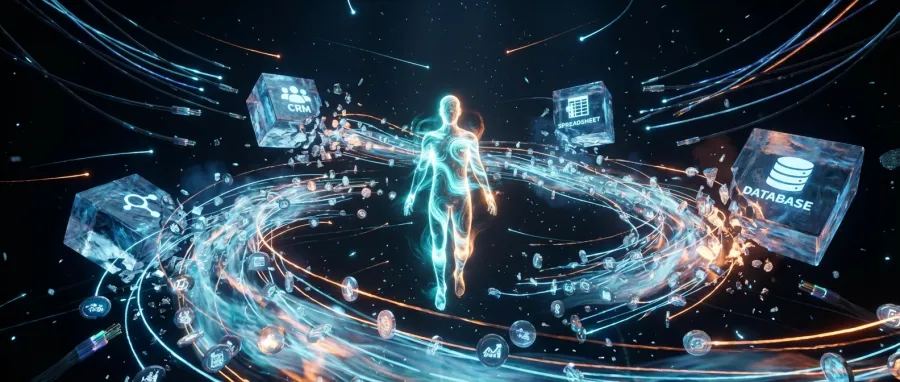
Software as a Service (SaaS) has long relied on three moats: data trapping, workflow lock-in, and integration complexity. Claude Code and its underlying agents are effectively eroding these barriers from the inside out.
Why does a company need to pay for a complex CRM if Claude Code can query a database and generate a custom chart on demand? The need for human-centric user interfaces is slowly disappearing.
If an agent doesn't need to click buttons, then the design of the buttons no longer matters. Every bit of traditional UX is at risk. We are entering an era of "headless" enterprise software driven by Claude Code.
Microsoft is perhaps at the greatest risk here. Their business model is built on seat-based productivity software. But Claude Code is shifting the value from the "seat" to the "outcome."
Tableau, Figma, and even Salesforce are wrappers for workflows that agents can now scaffold themselves. When you can describe an outcome and have Claude Code build the tool to achieve it, the wrapper becomes irrelevant.
Microsoft's Dilemma in the Face of Claude Code
Microsoft finds itself in a precarious position. They are one of the largest AI clouds, renting GPUs to labs like Anthropic. Yet, those same GPUs power Claude Code, which threatens their Office 365 empire.
They are renting the "barbarians" the very tools needed to tear down their castle. While Microsoft has its own Copilots, they often feel like additions to an old paradigm. Claude Code feels like a new one.
The definition of "human clickable buttons" is Microsoft. But as agents move toward direct data interaction, those buttons become a liability. The pattern of usage is shifting away from the GUI toward the agent.
Internal adoption of Claude Code at high-growth tech firms is already eating into the time spent in traditional Office apps. The terminal is becoming the new dashboard. The CLI is the new executive suite.
OpenAI must also respond. They risk becoming an infrastructure company that sells tokens while Anthropic sells solutions. Claude Code is a solution that people are willing to pay a premium for.
Why Anthropic is Winning with Claude Code
The big question in the AI world is why Claude Code is dominating despite fierce competition. The answer isn't just "better reasoning." It is a technical concept called token efficiency.
Models like Opus 4.5, which powers Claude Code, achieve much better results with fewer tokens. This matters immensely for long-horizon tasks. If an agent wastes tokens on nonsense, it eventually loses the thread.
Long-horizon performance is about compounding signals over multiple steps. Claude Code is designed to have the cleanest signal-to-noise ratio in the industry. It doesn't spam tokens; it uses them with precision.
In multi-context window planning, any small error leads to total failure at the end of the task. Claude Code succeeds because it minimizes these compounding errors. It stays coherent longer than any other agentic system.
While other models might score higher on specific benchmarks, Claude Code wins on the "real world" benchmark of getting the job done. This is the difference between a student who tests well and a worker who produces.
Task Horizons and the Future of Claude Code
The true measure of an agent is its task horizon. How long can it work before it fails? Currently, autonomous task horizons are doubling every four to seven months, a trend accelerated by Claude Code.
A 30-minute horizon allows for auto-completing snippets. A five-hour horizon allows for refactoring an entire module. A multi-day horizon allows for a completely autonomous audit of a company’s entire software stack.
Anthropic is clearly pushing for these longer horizons. Claude Code is built on an architecture that supports sub-agents and verification loops. It can spawn "armies" of smaller agents to handle sub-tasks in parallel.
This parallelization is the new "Chain of Thought." Instead of one long line of reasoning, Claude Code uses a swarm of reasoning. This approach is far more robust and less prone to the "incoherence" that plagues single models.
As these horizons expand, the amount of work an individual can produce will skyrocket. We are approaching a point where a single person with Claude Code can do what once required a team of fifty engineers.
- Short Horizon: Fixing a single bug in ten minutes.
- Medium Horizon: Implementing a new feature over four hours.
- Long Horizon: Migrating an entire legacy codebase over a weekend.
- Ultra Horizon: Maintaining and evolving a product suite for months autonomously.
Claude Code as the New TCP/IP
In the early days of the internet, there were many competing protocols. Eventually, TCP/IP won because it was the most efficient way to move packets. We are at that same point with AI models and Claude Code.
Claude Code is the first real proof point of a new "agentic" protocol. It’s not about the model itself; it's about how the model is orchestrated to interact with the world. It’s the new foundation of computing.
The future isn't about having a better chatbot. It's about how agents can harness tokens to build bigger and more complex projects. Claude Code is our best glimpse into this agentic future.
Information work is about to accelerate at a rate that will make the last decade look like it was standing still. The marginal cost of creating software is effectively heading toward zero. This changes everything.
We are seeing the birth of a new era where the model is the computer. Claude Code is the operating system for that computer. Those who adopt it first will have a massive head start in the new economy.
Comparing Agent Performance in Claude Code
To truly appreciate the tool, you have to see the benchmarks. In real-world coding tests, Claude Code consistently outperforms competitors not just in accuracy, but in the time taken to reach a solution.
Latency matters. If an agent takes ten minutes to think about a one-minute task, it loses its utility. Claude Code has optimized the relationship between thinking time and action time to a remarkable degree.
We are also seeing that realized speed can be much faster even with slower tokens per second. This is because Claude Code doesn't take as many "wrong turns" as other models. It is more direct and purposeful.
By using the smart scheduling features found in GPT Proto, developers can ensure they are always using the most efficient version of Claude Code for their specific task. This optimization is the key to scaling agentic workflows.
GPT Proto’s unified standard allows for a single interface to manage all these different model formats. This reduces the friction of switching between performance-heavy tasks and cost-sensitive background maintenance.
The Human Element in a Claude Code World
Does this mean humans are obsolete? Not at all. It means the "human-in-the-loop" has a much higher lever to pull. The human becomes the strategist, the architect, and the final judge of quality.
Working with Claude Code requires a different set of skills. You need to be better at defining problems than solving them. You need to understand the "why" more than the "how."
This is a liberating shift for creative minds. It removes the drudgery of syntax and allows for pure creation. We are seeing engineers "vibe code" video games for their families in a single afternoon.
The barrier to entry for building complex software has never been lower. Claude Code is the great equalizer, allowing anyone with a good idea and a terminal to build professional-grade tools.
However, we must also be wary of the "atrophy" mentioned by Karpathy. As we rely more on Claude Code, our manual skills will fade. We must ensure we still understand the underlying principles of the world we are building.
The Path Forward for Claude Code
We are only at the beginning of the Claude Code journey. As Anthropic continues to train larger and more efficient models, the capabilities of this CLI tool will only expand. It is a living product.
The next step is deeper integration with the physical world and specialized hardware. Imagine an agent that can not only write code but also optimize the very chips it runs on. That is where we are headed.
Companies that fail to integrate Claude Code into their workflows will find themselves unable to compete on speed or cost. The "vibe coding" revolution is not a trend; it is a fundamental re-architecting of labor.
We must embrace this agentic future while remaining critical of its impact on our skills and our society. The power of Claude Code is immense, and with that power comes a new kind of responsibility for creators.
Ultimately, Claude Code is a tool for human empowerment. it allows us to speak our intentions into existence. It turns the terminal from a place of cryptic commands into a portal for infinite possibility.
Conclusion: Embracing Claude Code
The world of intelligence work has changed forever. The marginal cost of processing information and creating software has been irrevocably altered by tools like Claude Code. This is the new reality.
Incumbents who ignore this shift do so at their own peril. The rise of agents is the most significant event in computing since the invention of the internet itself. It is the inflection point we have all been waiting for.
Claude Code is the first website into the future. It is our best proof that the "agentic" era is not just a marketing term, but a functional, revenue-generating, and world-changing technology that is here today.
Whether you are a developer, an executive, or a curious observer, the message is clear: pay attention to the terminal. That is where the future is being written, one commit at a time, by Claude Code.
The race is on, and it is more open than it was last year. We are excited to see the pace of change continue as we all learn to work alongside our new agentic partners in this brave new world.
Original Article by GPT Proto
"We focus on discussing real problems with tech entrepreneurs, enabling some to enter the GenAI era first."