Why the Right upscale iamge Matters in 2024
We've all been there. You find the perfect reference shot or an old family photo, but it's a blurry, pixelated mess. Trying to perform a quality upscale iamge used to mean smearing pixels around in Photoshop and hoping for the best. It wasn't great.
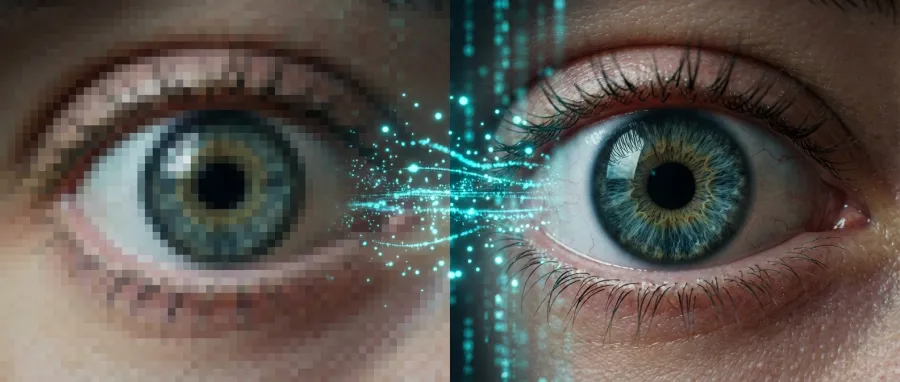
But the tech shifted. Now, we aren't just stretching pixels; we are generating new ones. Using a modern AI approach to upscale iamge allows us to reconstruct lost details. It's the difference between a blurry zoom and a crisp, high-definition recovery.
I’ve spent hundreds of hours testing different workflows. Some tools are fast, others are surgical. Choosing how you upscale iamge depends entirely on your source material. A grainy 90s Polaroid needs a different touch than a low-res Midjourney export.
Solving the Grainy Photo Problem with upscale iamge
Grain is the enemy of a clean upscale iamge. If you just pump a noisy photo through a basic upscaler, the AI often mistakes the noise for detail. You end up with "sharpened noise," which looks horrific and artificial.
The trick is using an AI that understands texture. When I perform an upscale iamge on old photos, I look for models that specialize in denoising first. Tools like Remini have become legendary here because they prioritize face reconstruction over raw pixel count.
It's about balance. You want a clear upscale iamge that doesn't look like a plastic filter. Real skin has pores; real paper has tooth. If your upscale iamge removes all of that, you've lost the soul of the photo.
"The best upscale iamge results come from knowing when to stop. Pushing the denoise too hard turns a memory into a mannequin."
Choosing the Best upscale iamge Strategy
Are you looking for speed or perfection? For a quick upscale iamge to post on social media, a mobile app is fine. But if you're printing a canvas, you need a heavy-duty API or a local stable diffusion setup.
I usually categorize an upscale iamge into two buckets: restorative and generative. Restorative fixes what’s broken. Generative adds what’s missing. Most modern AI tools do a bit of both, but their "opinion" on the data varies wildly.
When you start a new upscale iamge project, look at your edges. Are they jagged (aliasing) or blurry (interpolation)? This tells you which AI model to pick. A clean upscale iamge requires matching the tool to the specific artifacting in your source file.
Don't be afraid to experiment. Sometimes the "wrong" tool for an upscale iamge gives the most creative result. But generally, sticking to proven community favorites saves you hours of frustration and wasted API credits.
Top Tools for Your Next upscale iamge Task
The market is flooded right now. Every "AI photo editor" claims to have the best upscale iamge algorithm. Honestly? Most of them are just wrappers for the same few open-source models. You have to look deeper to find the gems.
I've narrowed down the field based on what actually works in a production environment. Whether you need a free upscale iamge or a paid professional suite, these are the tools that Redditors and pros actually swear by daily.
Wait, before we get into the list—remember that price doesn't always equal quality. Some of the most impressive upscale iamge results I've seen came from totally free, open-source software. It’s all about the underlying AI model architecture.
Open Source Freedom for upscale iamge
If you want a powerful, free upscale iamge without the corporate bloat, Upscayl is the clear winner. It’s open-source and cross-platform. It gives you that "natural" look that many paid AI tools struggle to replicate without over-sharpening.
For anime lovers, Waifu2x is still "old but gold." It was designed specifically for illustrations and 2D art. Even years later, its ability to handle flat colors and sharp lines during an upscale iamge is hard to beat.
The beauty of open-source is the lack of "pay-to-play" gates. You get the full power of the AI for every upscale iamge. However, you do need a decent GPU if you’re running these locally, or a reliable API provider.
I personally use Upscayl when I want a "set it and forget it" upscale iamge. It’s simple, effective, and doesn't try to upsell me on a subscription every five minutes. It’s a tool for practitioners, by practitioners.
| Tool |
Best For |
Price |
| Upscayl |
Natural Photos |
Free |
| Waifu2x |
Anime / Art |
Free |
| Remini |
Old Grainy Pics |
Freemium |
Commercial Powerhouses for upscale iamge
Topaz Gigapixel AI is the industry standard for a reason. It delivers crazy sharp details. But here's the catch: it can feel "too AI" if you push the upscale iamge settings to the extreme. Moderation is key here.
Remini is another heavy hitter, especially on mobile. It is shockingly good at fixing old, grainy photos. If you have a blurry shot of your grandparents, this is likely the upscale iamge tool that will save it.
Then there's the API route. For developers or power users, connecting to a high-end AI through an API allows for batch processing. You can automate an upscale iamge for thousands of files without breaking a sweat.
Managing these costs is tricky. High-end AI models consume a lot of compute. If you're doing heavy upscale iamge work, you should manage your API billing carefully to avoid surprise charges at the end of the month.
Advanced Models: SeedVR2 vs. Klein 9B for upscale iamge
Now we’re getting into the enthusiast territory. If you hang out in AI communities, you’ve heard these names. These aren't just apps; they are specific model architectures designed to squeeze every bit of data out of an upscale iamge.
SeedVR2 is currently hailed as the "GOAT" by many. It’s fast and maintains detail without adding weird artifacts. When I need a reliable, high-fidelity upscale iamge, SeedVR2 is usually my first choice in the workflow.
But Klein 9B is the dark horse. It’s incredibly versatile. It doesn't just upscale; it edits. It can fix anatomy errors in AI-generated art while performing the upscale iamge. That’s a level of intelligence most tools simply don’t have.
Choosing between them is a matter of intent. Do you want to keep the original exactly as it is, or do you want the AI to "fix" things during the upscale iamge? Both have their place in a professional's toolkit.
Why SeedVR2 is the G.O.A.T. for upscale iamge
The praise for SeedVR2 isn't just hype. It's really good at maintaining noise-to-signal ratios. In a standard upscale iamge, you often lose the "vibe" of the original photo. SeedVR2 seems to understand the texture better than most.
It’s also surprisingly fast. In the world of AI, "fast and good" is a rare combo. Usually, a high-quality upscale iamge takes minutes per frame. SeedVR2 cuts that down significantly, making it viable for larger projects.
Users on Reddit often pair it with other tools. You might use one tool for the initial cleanup and then send it to SeedVR2 for the final upscale iamge to 4K resolution. It’s a powerhouse for photorealism.
I've found that SeedVR2 handles skin tones better than almost anything else. It avoids that weird "waxy" look that plagues many AI models. If you want a believable upscale iamge, this is your best bet.
Fixing Anatomy and Artifacts with Klein 9B upscale iamge
Klein 9B is what I use when the source image is actually a bit broken. Maybe there's a JPEG artifact on a face or a weirdly shaped hand in an AI-gen shot. A standard upscale iamge would just make those errors bigger.
Klein 9B is "smarter." It performs subtle or not-so-subtle editing during the upscale iamge process. It can remove compression artifacts that have been baked into the file for decades. It's essentially a restoration specialist.
I’ve used it on 80s and 90s digital photos that were originally captured at tiny resolutions. The upscale iamge quality is stunning. It’s like the AI "remembers" what the scene should have looked like and draws it back in.
If you're dealing with "fried" images—those that have been saved and re-saved until they are blocks of color—Klein 9B is the only way to go for a successful upscale iamge. It’s a surgical tool for messy data.
Pro Workflows to Perfect Your upscale iamge Output
A single click rarely gives you a perfect result. Real pros use workflows. They stack models, use control nets, and iterate. If you want a world-class upscale iamge, you have to be willing to get your hands dirty with the process.
One popular method involves upscaling and then downscaling. It sounds crazy, right? But upscaling 4X and then downscaling back to a slightly lower resolution often "tightens" the pixels, resulting in a much cleaner upscale iamge than a direct 2X jump.
You also need to think about composition. Using something like a ControlNet Tile model allows you to maintain the "bones" of your image during a heavy upscale iamge. It ensures that your 4K version doesn't drift away from the original intent.
And don't forget the prompt. If you're using a generative AI for your upscale iamge, your text tags (like those from JoyTag) help the AI understand what it’s looking at. If it knows it's "silk," it will render silk textures.
Mastering the Photorealistic upscale iamge Loop
For photorealism, the "tiled diffusion" method is king. It breaks the image into small squares, performs the upscale iamge on each, and then stitches them back together. This prevents the AI from getting confused by large-scale compositions.
I start with a 4X pixel upscale. Then, I run a "high denoise" pass with a KSampler. This adds back the fine details—the pores, the fabric weave, the dust—that make an upscale iamge look like a real photograph.
The final step is usually a trip to SeedVR2. This acts as the "glaze" that brings everything together. It’s a multi-step upscale iamge process, but the results are indistinguishable from high-res native captures. It’s pure magic.
If you're using Photoshop, here's a pro tip: do lots of small increments. Instead of jumping from 1000px to 4000px in one go, do four 25% jumps. This "incremental" upscale iamge technique often preserves edge integrity better than one massive leap.
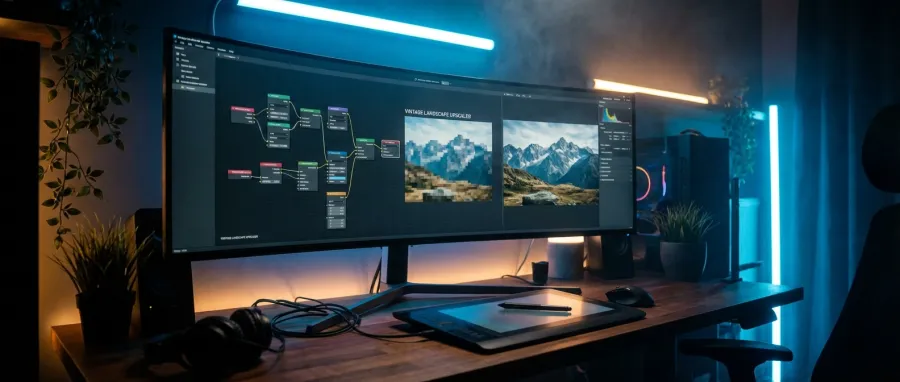
"A pro upscale iamge isn't a single action; it's a conversation between the original data and the AI's creative reconstruction."
Handling Anime and Illustrations with upscale iamge
Anime is a different beast. You don't want skin pores; you want flat, clean gradients and razor-sharp line art. Using a photorealistic model for an anime upscale iamge will result in "creepy" realistic textures on 2D faces.
ControlNet Tile is essential here. It keeps the lines where they belong. When you perform an upscale iamge on illustrations, you want to focus on "Analog Madness" or specialized SDXL models that understand cell shading and line weight.
I've found that older tools like Waifu2x are still surprisingly competitive here. They don't try to be too smart. They just give you a clean, crisp upscale iamge that respects the original artist's flat style. Simple is often better.
If you’re working with a lot of different styles, you might want to explore all available AI models to find one that specifically fits the aesthetic of your artwork. Every model has a "signature."
Performance and Privacy in upscale iamge
Where does the processing happen? This is a huge question for both performance and privacy. An upscale iamge requires significant compute power. If you do it on your phone, it might take a while or drain your battery.
Cloud-based tools are fast because they use massive server farms. But then you're uploading your private photos to someone else's server. For many, that's a dealbreaker. This is where on-device upscale iamge tools like Pixelo come in.
Privacy matters. If you're working with sensitive client data or personal family photos, you want an upscale iamge solution where the photos never leave your hardware. It’s a trade-off between speed and security.
Then there's the cost of scale. If you're a developer building an app, you need a reliable API. You can read the full API documentation for various providers to see how they handle image data and throughput limits.
On-Device vs. Cloud-Based upscale iamge
Pixelo is a great example of the "privacy first" movement. It offers 100% on-device AI for an upscale iamge on iOS. No servers, no data harvesting. It’s slower than a 4090-powered cloud server, but your data stays yours.
Cloud-based solutions, on the other hand, are the way to go for bulk work. If you need to perform an upscale iamge on 500 product photos, you don't want your laptop fans screaming for three days. You want a massive API to crush it in minutes.
I usually use a hybrid approach. Personal stuff gets an on-device upscale iamge. Heavy production work goes to the cloud. You just have to be aware of where your data is traveling during every upscale iamge session.
If you want to test how these models perform in the cloud without committing to one platform, you can upscale iamge using the GPT Proto unified interface, which gives you access to multiple state-of-the-art models in one place.
Managing API Costs for upscale iamge
Compute isn't free. Whether you're using OpenAI, Midjourney, or specialized upscalers, the API costs can add up fast. A high-resolution upscale iamge is one of the most resource-intensive tasks an AI can perform.
Here’s the thing: many people overpay because they use "performance-first" modes when "cost-first" would have been fine. For a basic upscale iamge, you don't always need the most expensive 9-billion parameter model. Sometimes a smaller model does the job.
To keep things efficient, I recommend using a unified API platform. It allows you to switch between models based on the specific upscale iamge task. This prevents you from being locked into one expensive provider when a cheaper one might be better for anime or text-heavy images.
Always monitor your API usage in real time. It’s easy to get carried away when you see how good the results are. One minute you're doing one upscale iamge, the next you've processed your entire 10,000-photo library and your credit card is crying.
Smart scheduling can also save you money. Some platforms offer discounts for "performance-last" processing. If you don't need your upscale iamge result in three seconds, you can save up to 70% by letting the API process it during off-peak times.
The Final Verdict on Choosing Your upscale iamge
So, what’s the move? If you’re a hobbyist, start with Upscayl. It’s free, it’s local, and it gives a very natural-looking upscale iamge. There’s almost no learning curve, and the results will beat any "traditional" sharpening filter you've ever used.
If you’re a professional photographer, buy Topaz. The sharpness is unmatched, even if it requires a little bit of masking and blending to make it look 100% real. It’s the most consistent upscale iamge tool for professional high-res printing.
And if you’re a developer or an AI enthusiast, dive into the SeedVR2 and Klein 9B ecosystem. These are the models pushing the boundaries of what an upscale iamge can actually do. They are the future of digital restoration.
Whatever you choose, remember that the "source" is still important. AI is powerful, but a better starting image always leads to a better upscale iamge. Take the best photo you can, and let the AI take it the rest of the way.
Best Fit for Every upscale iamge Use Case
For those who just want an "easy button," Remini is your friend. It’s the most user-friendly way to get a high-quality upscale iamge on your phone. Just be prepared for the subscription prompts—they are persistent, to say the least.
For the privacy-conscious, stick to on-device tools like Pixelo. It’s a breath of fresh air to have an upscale iamge tool that doesn't want your email address or your cloud storage permissions. It just works, right there on your silicon.
If you're looking for the absolute cutting edge, keep an eye on the latest AI industry updates. The field of upscale iamge tech is moving faster than almost any other sector of AI. What’s "the GOAT" today might be obsolete in six months.
At the end of the day, an upscale iamge is a tool to help you tell a story or preserve a memory. Don't get too bogged down in the technicalities. Find a tool that fits your workflow, gives you results you love, and stick with it until the next big thing arrives.
If you're a power user looking to integrate these capabilities into your own projects, you should definitely try GPT Proto intelligent AI agents. They can automate the entire upscale iamge pipeline, from denoising to final 4K export, using the world's leading models through a single API.
Written by: GPT Proto
"Unlock the world's leading AI models with GPT Proto's unified API platform."